

You pull a shot, pour your cup, take that first sip, and something is just… off. Maybe it’s flat, bitter, or inconsistent from one morning to the next. The frustrating truth is that even great beans can’t save a poorly equipped setup. Research consistently shows that the right tools close the gap between mediocre home coffee and café-quality results. This guide walks you through the six most important coffee accessories, how to choose them, how to match them to your brew method, and how to keep them performing at their best for years to come.
Table of Contents
- How to choose the right coffee accessories
- Top 6 essential coffee accessories for home brewing
- Comparing coffee accessories: Performance and value
- Matching accessories to your brew method
- Maintenance, cleaning, and longevity tips
- What most coffee accessory lists miss
- Level up your coffee routine with fresh beans
- Frequently asked questions
Key Takeaways
| Point | Details |
|---|---|
| Start with grinder and scale | Prioritizing a quality grinder and precise scale provides the greatest improvement in home coffee. |
| Match tools to brew method | Select your accessories based on your preferred brewing style for best results. |
| Maintain for lasting results | Regular cleaning keeps accessories effective and preserves coffee flavor over time. |
| Fresh beans matter | Pair upgraded accessories with fresh, specialty coffee beans for a complete home café experience. |
How to choose the right coffee accessories
Before you spend a dollar, you need a clear picture of what you actually want from your coffee setup. Not every accessory works for every brewer, and buying the wrong tool wastes both money and counter space.
Start with three questions: What brew method do you use? What’s your budget? And what flavor outcomes matter most to you? Your answers shape everything. Essential tools for home coffee brewing confirm that your brew method dictates accessories: pour-over prioritizes a scale and kettle, espresso demands a tamper and frother, and French press brewing focuses on coarse grind consistency and proper storage.
Here are the key criteria to evaluate any accessory before buying:
- Brewing compatibility: Does this tool work with your specific method?
- Precision impact: Will it improve consistency, extraction, or temperature control?
- Budget fit: Is the price justified by the flavor improvement it delivers?
- Kitchen footprint: Do you have the space to store and use it comfortably?
- Durability: Is it built to last, or will you replace it in six months?
Some accessories are foundational regardless of brew style. A good grinder and a reliable scale belong in every setup. Others, like a gooseneck kettle or a milk frother, are method-specific investments. Knowing the difference helps you prioritize what to buy first versus what to add later.
If you’re just getting started, check out these must-have coffee tools to see what a solid beginner setup looks like in practice.
Pro Tip: Build your accessory kit in layers. Start with the two foundational tools (grinder and scale), then add method-specific gear once your fundamentals are dialed in.
Top 6 essential coffee accessories for home brewing
Now that you know what to consider, let’s explore the essential accessories every home barista should own.
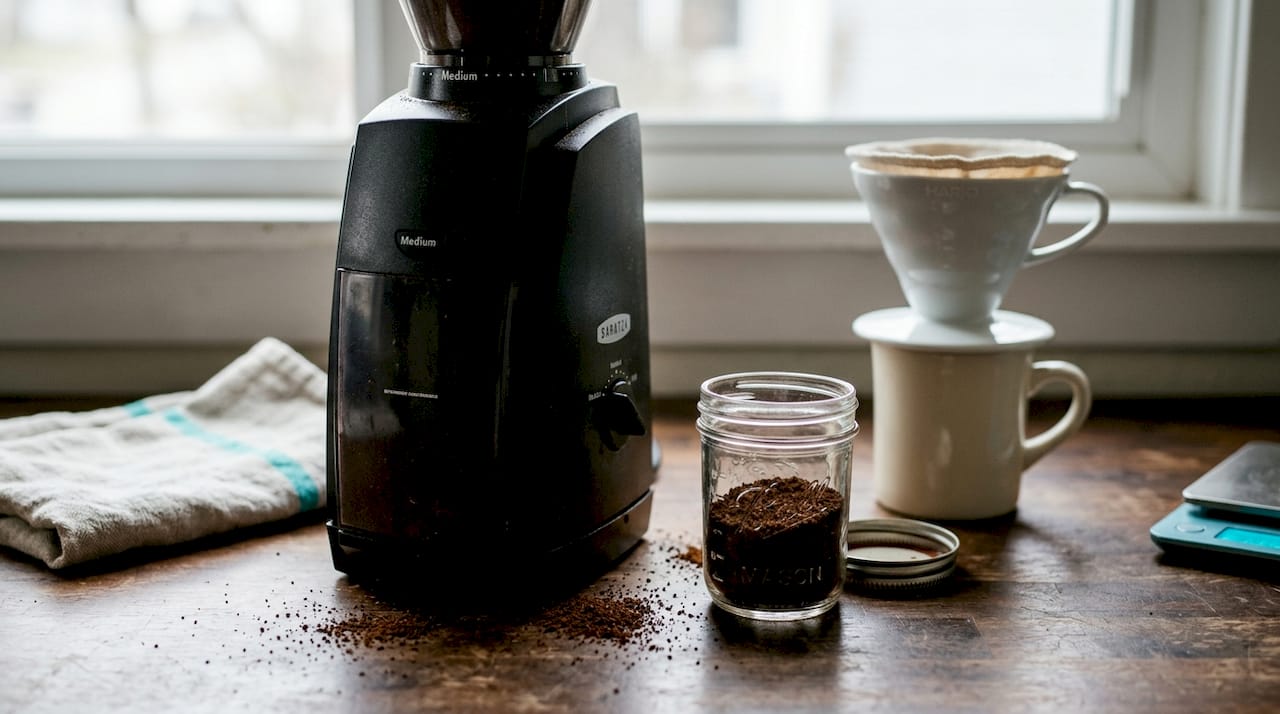
1. Burr grinder A burr grinder is essential for consistent grind size across every brewing method. Unlike blade grinders, burr grinders crush beans between two abrasive surfaces, producing uniform particles that extract evenly. Uneven grinds lead to bitter or sour cups. Look for adjustable grind settings and a hopper capacity that fits your daily use. For expert grinder recommendations, both budget and premium options are covered in depth.
2. Digital scale A digital scale with 0.1g precision is crucial for measuring coffee-to-water ratios in the 1:15 to 1:18 range, ensuring repeatable brews every single time. Eyeballing coffee doses is one of the most common reasons home brews taste different each day.
3. Gooseneck kettle A gooseneck kettle enables precise pouring control for pour-over, maintaining optimal water temperature between 195 and 205°F. The narrow spout lets you control flow rate and direction, which directly affects extraction quality.
4. Airtight storage container Oxygen is coffee’s enemy. An airtight container with a one-way valve keeps beans fresh by minimizing oxidation. Look for opaque containers that also block light.
5. Pour-over dripper and filters A quality dripper paired with the right filters shapes your brew’s body and clarity. Paper filters produce a clean, bright cup; metal filters allow more oils through for a richer texture. Browse popular pour-over accessories to find options that fit your style.
6. Cleaning supplies Brushes, microfiber cloths, and grinder cleaning tablets round out any serious setup. Residue buildup affects flavor more than most brewers realize.
“The single biggest upgrade most home brewers can make isn’t a new machine. It’s a burr grinder and a scale used together, consistently.” — Specialty coffee professionals
Pro Tip: When buying a kettle, choose one with a built-in thermometer or temperature control. Guessing water temperature is one of the easiest ways to ruin an otherwise perfect brew.
Comparing coffee accessories: Performance and value
With a sense of which accessories matter, let’s compare what makes each stand out or fall short.
The biggest performance gap in any home setup is almost always the grinder. Experts emphasize burr grinders over blade grinders for uniform particle size, which is critical for balanced extraction. Blade grinders create a mix of fine dust and large chunks, leading to bitter over-extracted notes and sour under-extracted ones in the same cup.
| Accessory | Key feature | Flavor impact | Entry-level cost |
|---|---|---|---|
| Burr grinder | Uniform grind size | Very high | $40 to $150 |
| Digital scale | 0.1g precision | High | $15 to $50 |
| Gooseneck kettle | Pour control + temp | High (pour-over) | $25 to $80 |
| Airtight container | Oxidation barrier | Medium | $10 to $30 |
| Pour-over dripper | Brew control | Medium to high | $10 to $45 |
| Cleaning supplies | Residue prevention | Medium | $10 to $25 |
Where to save: Airtight containers and cleaning supplies don’t need to be expensive. A $15 container with a good seal works just as well as a $60 designer version.
Where to splurge: The grinder. A $100 burr grinder will improve your coffee more than a $300 espresso machine upgrade if your current grinder is a blade model.
For those building out espresso brewing needs, the priority list shifts slightly. A tamper, a pressurized portafilter basket, and a milk frother become important additions once the grinder and scale are in place.
- Burr grinders: Conical burrs are quieter; flat burrs offer more precision at higher price points
- Scales: Timer-integrated models are worth the small premium for pour-over and espresso
- Kettles: Variable temperature models eliminate guesswork entirely
Matching accessories to your brew method
To get the very best results, you’ll want to tailor your tools to how you like to brew.
No single setup works for everyone. Brew method dictates accessories: pour-over prioritizes a scale and kettle, espresso needs a tamper and frother, and immersion methods like French press focus on coarse grind consistency and quality storage.
| Brew method | Required accessories | Recommended additions |
|---|---|---|
| Pour-over | Burr grinder, scale, gooseneck kettle | Dripper, paper filters, timer |
| Espresso | Burr grinder, tamper, scale | Milk frother, portafilter basket |
| French press | Burr grinder, airtight container | Coarse grind setting, timer |
| Automatic drip | Burr grinder, airtight container | Scale, water filter |
| Cold brew | Coarse grinder, storage jar | Fine mesh filter, scale |
Here’s a simple step-by-step process for matching your accessories to your method:
- Identify your primary brew method (the one you use most days).
- List the required accessories from the table above and acquire those first.
- Add the recommended accessories once your core setup is working well.
- Evaluate your results after two weeks and identify any weak points.
- Upgrade or add accessories based on what’s limiting your cup quality.
For those exploring cold brew accessory needs, the focus shifts to a coarse grind, a large-capacity container, and a fine mesh filter to avoid sediment in the final cup.
Small investments often make the biggest difference. Adding a simple timer to your French press routine, for example, can immediately improve consistency without spending anything if you already own a phone.
Maintenance, cleaning, and longevity tips
No list is complete without knowing how to maintain your investment.
Coffee leaves behind oils and fine particles in every piece of equipment it touches. Over time, those residues turn rancid, and that off flavor ends up in your cup. Cleaning supplies and tools like brushes and microfiber cloths prevent residue buildup that directly affects flavor quality.
Here’s what a solid cleaning routine looks like for each major accessory:
- Burr grinder: Brush out the burrs and hopper after every use. Run a grinder cleaning tablet through it once a week to dissolve oil buildup.
- Digital scale: Wipe the surface with a damp cloth after each session. Keep it away from moisture to protect the sensors.
- Gooseneck kettle: Descale monthly using a 1:1 mix of water and white vinegar. Rinse thoroughly before the next brew.
- Airtight container: Wash with warm soapy water weekly. Let it dry completely before refilling to prevent moisture contamination.
- Pour-over dripper: Rinse immediately after each use. Deep clean with a mild dish soap once a week.
Common issues and quick fixes:
- Grinder clogging: Usually caused by oily or dark roast beans. Brush more frequently and run cleaning tablets every few days.
- Kettle scaling: White mineral deposits form faster in hard water areas. Increase descaling frequency to every two weeks if needed.
- Stale-tasting coffee despite fresh beans: Almost always a dirty grinder or container. Clean both and taste the difference immediately.
Pro Tip: Keep a small brush next to your grinder so cleaning becomes a two-second habit after every brew, not a weekly chore you forget.
What most coffee accessory lists miss
Before we wrap up, here’s our candid perspective from years of brewing and testing gear.
Most home brewers fall into the same trap: they chase the newest gadget before they’ve mastered the basics. A $400 pour-over stand won’t fix a blade grinder. A temperature-controlled smart kettle won’t save a brew where the coffee-to-water ratio is off by 30%.
The honest truth is that prioritizing your grinder and scale first delivers the biggest flavor impact. Every other accessory enhances a foundation that’s already solid. Without that foundation, you’re decorating a house with a cracked frame.
We’ve seen brewers spend hundreds on aesthetics and automation while skipping a $50 burr grinder. The result is always the same: inconsistent, frustrating coffee that never quite gets there. Fancy gadgets can be fun, but they don’t compensate for poor basics.
Buy the grinder. Buy the scale. Use them every single day until measuring and grinding feel automatic. Then, and only then, start adding the extras. That sequence is the real secret behind consistently great home coffee.
Level up your coffee routine with fresh beans
Ready to take your upgraded setup to the next level?
The best accessories in the world can only do so much if your beans aren’t fresh. Every grinder setting, every precise measurement, every carefully controlled pour deserves coffee that’s actually worth brewing. That’s where we come in.
At Last Chapter Coffee, we offer specialty blends crafted for every method and every palate. Try the rich, complex 6 Bean Blend for a balanced everyday cup, or push your setup with the bold intensity of the Max Caf Blend. For something with bright, fruity character that shines in pour-over, the African Kahawa Blend is a standout choice. All orders ship free within the US.
Frequently asked questions
Do I really need a burr grinder for home coffee?
Yes. A burr grinder produces uniform particle sizes that extract evenly, which is the single most important factor in brewing a balanced, great-tasting cup at home.
What coffee-to-water ratio should I use with a digital scale?
Most specialty coffee experts recommend a 1:15 to 1:18 ratio, meaning 1 gram of coffee for every 15 to 18 grams of water, depending on your preferred strength.
How do airtight containers improve coffee freshness?
Airtight containers minimize oxidation exposure, which slows the degradation of flavor compounds and aroma in your beans, keeping them tasting fresher for longer.
Is a gooseneck kettle only useful for pour-over coffee?
Primarily yes. A gooseneck kettle’s precise pour control is most valuable for pour-over and manual methods; automatic drip machines don’t benefit from it in the same way.
How often should coffee tools be cleaned?
At minimum, rinse all brewing tools after every use and do a thorough weekly cleaning to prevent oil and residue buildup that can quietly ruin your coffee’s flavor.


