

A coffee tasting is a structured sensory event where participants evaluate distinct coffees by aroma, flavor, body, acidity, and finish to deepen their appreciation and sharpen their palate. Known professionally as “cupping,” this practice follows repeatable protocols used by roasters, buyers, and the Specialty Coffee Association worldwide. Whether you are hosting six friends around a kitchen table or organizing a formal flight for a coffee club, the principles stay the same. This guide walks you through every stage, from selecting your coffees to guiding guests through a systematic evaluation that actually teaches them something.
How to plan coffee tastings: selecting your coffee lineup
The most consequential decision in any tasting is which coffees you put on the table. Selecting 3 to 5 coffees gives guests enough variety to make meaningful comparisons without overwhelming their senses. Fewer than three and the contrast is too thin. More than six and palate fatigue sets in fast.
Build your lineup around three axes of contrast: origin, roast level, and processing method. A well-structured flight might include a light-roasted Ethiopian Yirgacheffe (bright, floral, citrus-forward), a medium Colombian Huila (balanced, caramel, mild acidity), and a dark Sumatran Mandheling (earthy, full-bodied, low acidity). That trio alone covers three continents, three roast levels, and two processing methods. Guests can immediately feel the differences rather than guess at them.
Mixing well-known commercial roasters with artisanal producers adds another layer of interest. It lets guests compare what “specialty” actually means in practice versus what they buy at a grocery store. The contrast is often more dramatic than people expect, and that surprise is what makes tastings memorable.
- Choose coffees that differ in at least two sensory dimensions (origin and roast, or processing and roast)
- Include one coffee guests already know to serve as a reference point
- Source from a diverse coffee collection that includes single origins and blends
- Note each coffee’s flavor profile before the event so you can guide discussion
Pro Tip: Order your coffees at least three days before the event. Freshly roasted beans need 24 to 72 hours of degassing after roast before they express their full flavor. Beans roasted the same morning will taste flat.
What equipment do you need to host a coffee tasting?
The right tools do not need to be expensive, but they do need to be consistent. Inconsistency in equipment is the fastest way to produce misleading comparisons between coffees.
| Tool | Purpose |
|---|---|
| Burr grinder | Produces uniform particle size for even extraction |
| Digital scale | Measures dose to the gram for repeatable results |
| Thermometer | Confirms water temperature before brewing |
| Cupping bowls or wide mugs | Allows aroma to concentrate before tasting |
| Cupping spoons | Deep-bowled spoons designed for slurping and aeration |
| Timer | Standardizes steep time across all samples |
| Tasting sheets | Gives guests a structured framework to record impressions |
Professional cupping uses 8.25 grams of coffee per 150 ml of water at 93 to 96°C with a four-minute steep. That ratio and temperature are not arbitrary. They produce a consistent extraction that isolates the coffee’s character rather than the brewer’s technique.
Arrange your space with natural light if possible. Artificial yellow lighting suppresses color perception and subtly affects how people describe flavors. Set samples in a row from lightest to darkest roast, labeled clearly with origin, roast level, and two or three tasting notes. Clear labeling guides participants and reduces the confusion that derails group discussions.
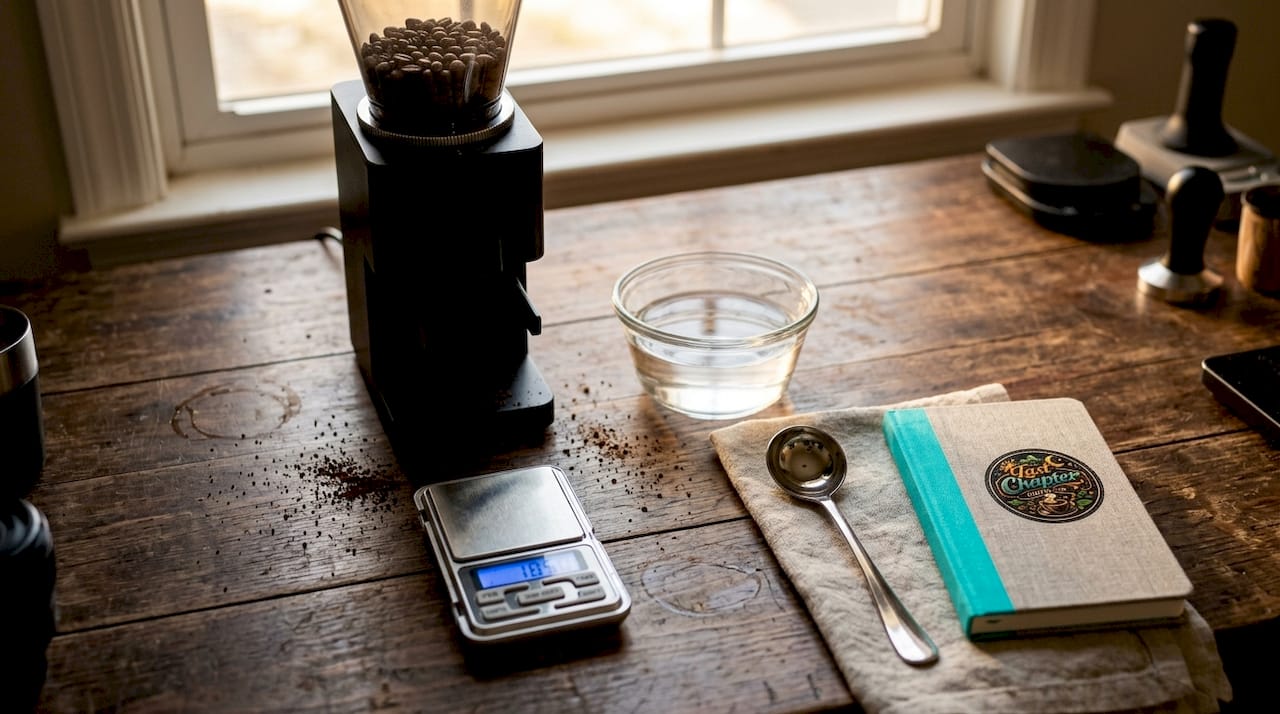
Pro Tip: Set out a glass of still water and a small cup of plain crackers at each seat. Guests should rinse their palate between coffees. Sparkling water is too assertive and interferes with delicate acidity notes.
How do you conduct a coffee tasting step by step?
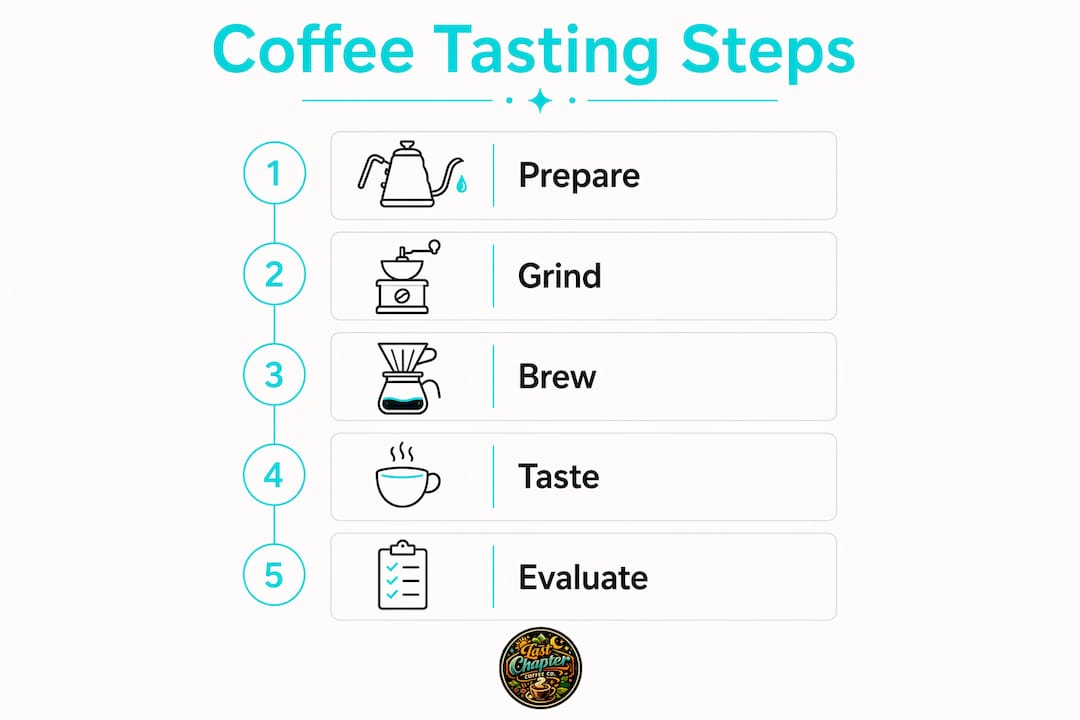
This is where structure pays off. Follow this sequence and your guests will taste more in 45 minutes than most people notice in a year of daily coffee drinking.
- Grind and dose. Grind each coffee immediately before brewing. Weigh 8.25 grams per 150 ml of water for each sample. Grind directly into the cupping bowl.
- Evaluate dry aroma. Before adding water, ask guests to lean over each bowl and inhale slowly. Dry grounds reveal roast character and origin notes that disappear once water is added. Have guests write one or two words on their tasting sheet.
- Add water and start the timer. Pour water at 93 to 96°C over all samples simultaneously. Start a four-minute timer.
- Break the crust. At four minutes, a crust of grounds forms on the surface. Use a cupping spoon to break it with three slow strokes. Lean in as you break it. The burst of aroma at this moment is the most intense sensory event in the entire tasting. Record impressions immediately.
- Skim the surface. Remove floating grounds and foam with two spoons. This clears the surface for clean tasting.
- Begin tasting in temperature windows. Start evaluating as the coffee cools to around 75°C and complete your assessment before it drops below 50°C. This window preserves volatile aroma compounds while balancing sweetness and acidity perception.
- Slurp, do not sip. Use a cupping spoon to draw coffee across the full width of your tongue with an audible slurp. This aerates the liquid and spreads it across all taste zones simultaneously. It feels awkward the first time and becomes instinctive by the third coffee.
- Evaluate in sequence. Work from lightest to darkest roast. Arranging coffees light to dark lets guests adjust gradually and catch subtle differences that a heavy roast would otherwise mask.
On your tasting sheet, record five attributes for each coffee:
- Aroma: What you smell before and after adding water
- Acidity: Brightness or tartness (think lemon versus apple versus none)
- Body: Weight and texture on the tongue (thin, medium, syrupy)
- Flavor: Specific taste notes (chocolate, berry, cedar, tobacco)
- Aftertaste: What lingers after swallowing and for how long
Consistent dose, grind, water temperature, and timing are what make comparisons reliable. A half-degree difference in water temperature or a 30-second variation in steep time shifts perceived sweetness and acidity enough to mislead your conclusions.
How do you keep guests engaged during a coffee tasting?
The tasting protocol handles the structure. Engagement is what makes it an event rather than an exercise.
Tasting scorecards are the single most effective tool for keeping guests focused. Scorecards and aroma maps improve focus and deepen sensory awareness by giving people a framework to organize what they are experiencing. Without a scorecard, most guests default to “I like this one” or “this one is bitter.” With one, they start noticing why.
The SCA Coffee Taster’s Flavor Wheel, developed with World Coffee Research, gives guests a visual vocabulary. Print copies and place one at each seat. When someone says a coffee tastes “fruity,” the wheel pushes them to specify: is it stone fruit, citrus, or berry? That specificity is where real learning happens.
- Introduce the flavor wheel before the first coffee and explain how to use it
- Ask one open question per coffee: “What does this remind you of?” or “Where does the acidity sit on your tongue?”
- Encourage disagreement. Two people tasting the same coffee often describe it differently, and that conversation is the point
- Food pairings like nuts, cheeses, and chocolates highlight or contrast flavor notes and encourage sensory exploration
- Keep music low and instrumental. Lyrics compete with concentration during aroma evaluation
A flavored coffees sample pack works particularly well for first-time tasting groups because the flavor cues are more accessible. Guests who have never done a cupping before find it easier to identify notes when the coffee has a defined flavor anchor like hazelnut or cinnamon. It builds confidence before you move to more nuanced single origins.
For a more adventurous lineup, a coffee with mushrooms medium roast creates an unexpected contrast point that generates real discussion. Most guests have never tasted anything like it, and that novelty keeps energy high.
Key takeaways
A well-planned coffee tasting requires diverse coffee selection, precise preparation, structured evaluation, and interactive elements that give guests a framework to articulate what they experience.
| Point | Details |
|---|---|
| Select 3 to 5 coffees | Choose coffees that differ in origin, roast, and processing for meaningful sensory contrast. |
| Standardize your prep | Use 8.25g per 150ml at 93 to 96°C with a four-minute steep for reliable comparisons. |
| Taste in temperature windows | Evaluate between 75°C and 50°C to capture the full aroma and flavor range of each coffee. |
| Use tasting sheets and flavor wheels | Structured tools give guests vocabulary and focus, turning preference into genuine evaluation. |
| Engage with food and discussion | Pairings and open questions deepen sensory awareness and make the event social and memorable. |
What I have learned from running tastings that most guides skip
After hosting more coffee tastings than I can count, the thing that consistently separates a great session from a forgettable one has nothing to do with the coffee. It is group size. Keep it to eight people or fewer. Beyond that, the group splits into side conversations, people stop recording their sheets, and the collective attention that makes a tasting work dissolves. I have seen beautifully curated lineups fall flat simply because the room was too big.
The second thing most guides understate is the value of repetition. Your palate is a muscle. The first time you cup a Yirgacheffe, you might catch “floral” and “bright.” The fifth time you cup one, you start distinguishing jasmine from bergamot. Run a tasting once a month for six months and you will develop more sensory vocabulary than most baristas acquire in a year of daily work.
I also push back on the instinct to make tastings rigorous. The Specialty Coffee Association emphasizes repeatable tasks in cupping for professional evaluation, and that discipline matters in a commercial context. But at home, the goal is joy and curiosity, not a calibration score. If someone wants to skip the dry aroma step because they find it awkward, let them. The worst outcome is a guest who feels like they failed a test. The best outcome is someone who goes home and orders a bag of Ethiopian coffee they would never have tried otherwise.
One practical note: the goal of a tasting is a repeatable sensory assessment tied to consistent conditions. That means your job as host is to control the variables so guests can focus on the coffee. Prep everything before anyone arrives. Grind fresh. Have water at temperature. The less you are troubleshooting during the event, the more you can guide the conversation.
— Rogee
Stock your next tasting with coffees worth talking about
The coffees you choose make or break the conversation. Lastchaptercoffee offers single origins, artisan blends, and curated sample packs that give you the sensory range a good tasting demands. The African Kahawa Blend is a strong anchor for any flight, with distinct flavor notes that guests can actually identify without a trained palate. For a broader selection to build your lineup, browse the full coffee collection and filter by roast level to build a light-to-dark progression. All orders ship free within the US, so you can order multiple bags without the math getting complicated.
FAQ
How many coffees should I include in a tasting?
Three to five coffees is the standard range for a home or casual tasting. Fewer than three limits meaningful comparison; more than five causes palate fatigue that makes later samples harder to evaluate accurately.
What water temperature is best for coffee cupping?
Pour water at 93 to 96°C over the grounds and begin tasting as the coffee cools to around 75°C. Complete your evaluation before the temperature drops below 50°C, since that window captures the full range of aroma and flavor compounds.
Do I need professional cupping spoons to host a tasting?
Professional cupping spoons help because their deep bowl is designed for slurping and aeration, but any deep-bowled spoon works for a home tasting. The slurping technique matters more than the spoon itself.
What is the difference between coffee cupping and a coffee tasting?
Cupping is the formal, standardized protocol used by the Specialty Coffee Association and commercial buyers, with precise ratios, temperatures, and scoring sheets. A coffee tasting is a broader term that can follow cupping protocols or adapt them for a more casual, social setting.
How do I help guests who are new to tasting describe what they taste?
Place a copy of the SCA Coffee Taster’s Flavor Wheel at each seat and ask guests to point to a category before narrowing to a specific note. Starting with broad categories like “fruity” or “nutty” before drilling down removes the pressure of finding the exact word immediately.


