

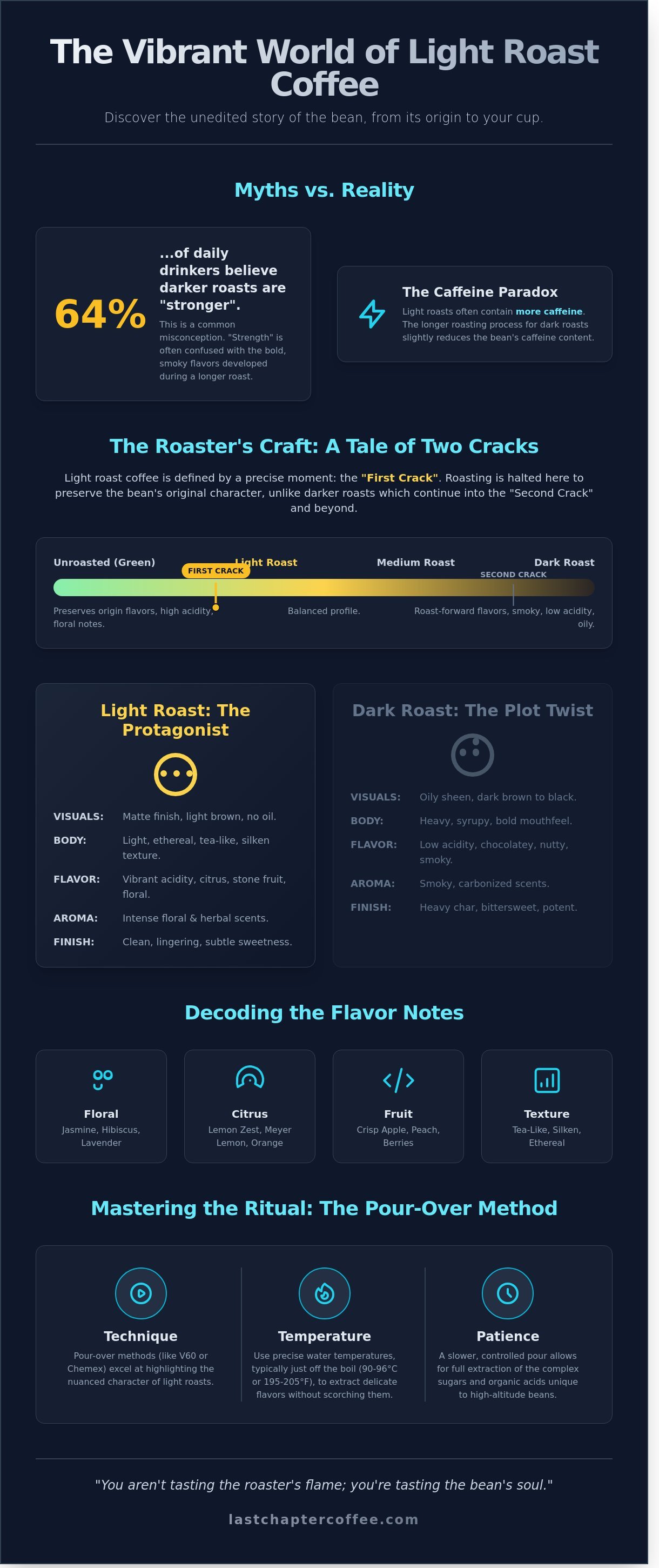
The most misunderstood chapter in the world of specialty beans isn't the bold dark roast; it's the unedited, vibrant story of the light roast. While 64% of daily drinkers in a 2024 Specialty Coffee Association survey still equate darkness with strength, the true complexity of a bean's origin only survives when the heat is stayed. You've likely encountered a cup of light roast coffee that tasted more like vinegar than velvet, leaving you to wonder if "brightness" is just a polite word for sour. It's a common frustration to seek a floral narrative only to find a sharp, biting bitterness that disrupts your quiet morning ritual.
We're here to help you rewrite that experience and discover the tea-like elegance hidden within the bean's soul. You'll learn to appreciate the precise moment of the first crack and how to distinguish between vibrant acidity and unpleasant astringency. By the end of this guide, you'll master the brewing techniques required to extract a cup filled with nuanced floral and fruity notes; this ensures your next pour is a perfect, lingering conclusion to your search for quality.
Key Takeaways
- Identify the "First Crack" and the visual cues that signal the start of a bean's vibrant sensory story.
- Decode a complex vocabulary of brightness to identify the citrus and berry notes that define a superior light roast coffee.
- Uncover the "Caffeine Paradox" to understand why these lighter, tea-like cups often offer a more potent start to your day.
- Master the pour-over technique and precise water temperatures to extract the full, nuanced character of high-altitude beans.
- Discover "The Prologue," a signature roast that bridges the gap between ethical sourcing and the perfect morning ritual.
The Prologue: Defining the Essence of Light Roast Coffee
Every compelling narrative requires a starting point; a moment where the potential of the protagonist is revealed but not yet altered by the weight of the plot. In the craft of roasting, this is the first crack. It's the singular, audible heartbeat that signals the birth of light roast coffee. While darker roasts continue their journey into the fire, we choose to pause here. We stop the clock the moment the bean's internal moisture turns to steam, causing the cellular structure to expand and pop. This precise intervention ensures the bean remains a vessel for its own history, capturing a snapshot of the farm's climate before the heat can rewrite the script.
Visually, these beans tell a story of restraint. They possess a matte finish, reminiscent of sun-bleached parchment or toasted cinnamon. Unlike their darker counterparts, they lack the oily sheen that suggests a long exposure to high temperatures. By 2026, data from specialty coffee associations suggests a 15 percent increase in the demand for "ultra-light" roasts among enthusiasts. These profiles push the boundaries of the coffee roasting process even further. They prioritize the raw, vibrant energy of the seed over the smoky influence of the drum. This trend isn't just a fad; it's a movement toward absolute transparency in every sip.
Preserving the Terroir
To roast light is to honor the farm. When beans grow at altitudes exceeding 1,500 meters, they develop a density that stores complex sugars and organic acids. These elements are the terroir, the literal taste of the earth and the rain. We treat single-origin beans as the protagonists of our collection. We balance heat and time with surgical precision in our 12-kilogram small-batch roasters. This prevents the fire from overwriting the delicate floral notes that the soil worked so hard to produce. It's a fragile equilibrium. One minute too long in the drum can turn a vibrant peach note into a generic caramel, losing the bean's unique identity forever.
Light Roast vs. The Rest of the Compendium
The difference in the cup is a matter of texture and clarity. While a dark roast provides a heavy, syrupy mouthfeel, a light roast offers a tea-like elegance. It's a shift from carbonized sweetness to a bright, citrus-forward acidity. Professional tasters often reach for these roasts because they're transparent. There's nowhere for defects to hide. You aren't tasting the roaster's flame; you're tasting the bean's soul. This clarity is why light roast coffee remains the gold standard for those who wish to explore the nuances of different coffee-growing regions. Consider these distinct characteristics:
- Body: Light and ethereal, often described as having a tea-like or silken texture.
- Flavor Profile: Dominant notes of jasmine, lemon zest, stone fruit, and crisp apple.
- Aroma: Intense floral and herbal scents that fill the room immediately upon brewing.
- Finish: Clean and lingering, leaving a subtle sweetness on the palate rather than a heavy char.
Choosing this roast level is an invitation to slow down. It's for the drinker who wants to peel back the layers of a flavor profile like the pages of a well-worn book. It's not about the caffeine kick alone; it's about the discovery of what makes a specific hillside in Ethiopia or a volcanic slope in Guatemala unique. We provide the prologue, but the sensory journey is yours to finish.
Character Development: Decoding Flavor Notes and Aromatics
Every bean carries a history. In the hands of a thoughtful roaster, a light roast coffee serves as the unfiltered manuscript of its origin. While darker roasts rely on the fire to create flavor through caramelization, light roasts preserve the intrinsic personality of the soil, the altitude, and the climate. This transparency allows a vibrant vocabulary of flavor to emerge. When you sip The Prologue, you aren't just tasting coffee; you're reading the first lines of a story written in high-altitude volcanic soil. You'll encounter a brightness that mimics the snap of a fresh Granny Smith apple or the zesty lift of a Meyer lemon. These citrus and stone fruit notes provide a structural backbone that feels alive on the palate.
The sensory journey continues with delicate floral undertones that often surprise the uninitiated. Jasmine, hibiscus, and even dried lavender can appear in the steam rising from your mug. These notes are fleeting and precious. They require a gentle touch during the roasting process to survive. This leads to what professionals call a tea-like quality. This isn't a critique of the coffee's strength; rather, it's an appreciation of its clarity and elegance. A high-quality light roast doesn't coat the tongue in heavy oils. Instead, it offers a clean, shimmering finish that leaves your palate refreshed and ready for the next chapter.
The narrative arc of the bean is also shaped by its processing. Washed coffees, where the fruit is removed before drying, emphasize a crisp and articulate acidity. They're the polished, edited drafts of the coffee world. In contrast, natural process beans are dried inside the cherry. This infuses the seed with wild, fermented notes of strawberry and blueberry. These methods dictate the "plot" of your morning cup, determining whether the experience will be one of structured elegance or rustic complexity.
The Science of Acidity
Acidity in coffee is often misunderstood as bitterness, yet it's the element that provides life and "sparkle" to the brew. Research published in 2023 by the Poznań University of Life Sciences highlights how roasting levels significantly impact the bioactive and aromatic compounds found within the bean. Specifically, light roasts retain higher concentrations of chlorogenic acids. These compounds contribute to the bright, tangy profile we crave and offer a higher antioxidant count than their darker counterparts. It's a delicate balance; true brightness feels intentional and sweet, whereas "sourness" is usually a sign of under-extraction during brewing rather than a flaw in the roast itself.
The Sweetness Hidden Beneath
Beneath the vibrant acidity of light roast coffee lies a subtle, foundational sweetness. Because the beans aren't roasted long enough to develop heavy molasses or carbon flavors, the sweetness must be inherent to the bean. You'll often find notes of raw cane sugar, white honey, or even the creamy sweetness of toasted almonds. Before your first sip, take a moment to inhale the dry aromatics. The scent of ground beans often reveals the "inciting incident" of the flavor profile, offering hints of what's to come. If you're ready to experience this nuanced balance for yourself, you might find your new favorite ritual when you explore our signature light roast collection and start your own sensory journey.
Debunking the Myths: Caffeine, Strength, and Stomach Comfort
The story of coffee is often written in broad, misunderstood strokes. Many drinkers believe that a darker bean signifies a more potent experience, while a light roast coffee is merely a gentle introduction. This is a common misreading of the bean's character. In reality, the "strength" of your cup isn't determined by the duration of the roast, but by the concentration of the brew. The Specialty Coffee Association (SCA) defines the ideal extraction through Total Dissolved Solids (TDS), typically aiming for a range between 1.15% and 1.35%. A light roast can be brewed to a staggering intensity, just as a dark roast can be diluted into a thin, watery ghost of its former self. We must separate the darkness of the narrative from the weight of the words.
The Caffeine Narrative
The energy within the bean is a steady pulse, not a volatile spirit easily scared away by heat. Caffeine molecules remain remarkably stable until they reach temperatures near 455 degrees Fahrenheit. Because most specialty roasts conclude well before this threshold, the chemical potential of the bean stays largely intact. The true divergence occurs in density. During the roasting process, beans lose approximately 15% to 20% of their mass as moisture evaporates and the cellular structure expands.
- Density and Volume: A scoop of light roast beans is heavier and denser than a scoop of dark roast. If you measure your coffee by volume, that single scoop of light roast contains more individual beans and, consequently, more caffeine.
- The 2015 Findings: Research published in the Journal of Food Science in 2015 confirmed that while caffeine levels per bean are relatively constant, the loss of physical mass in dark roasts means you'd need more beans by weight to match the caffeine in a lighter profile.
- Sustained Focus: Our Prologue roast offers a clarity of mind that feels like a well-paced chapter. It's a focused energy, devoid of the charred bitterness that often masks the bean's natural vibrance.
Is Light Roast Harder on the Stomach?
There's a persistent whisper that lighter roasts are the antagonists of a sensitive stomach. This belief stems from the presence of organic acids that haven't been scorched away by the flame. A 2010 study presented at the American Chemical Society highlighted that dark roasts contain higher levels of N-methylpyridinium (NMP), a compound that helps reduce the secretion of stomach acid. However, the perceived "sharpness" of light roast coffee is often a result of brewing technique rather than the bean's inherent nature.
You can rewrite this experience by adjusting your brewing variables. Lowering your water temperature to 195 degrees Fahrenheit, rather than the standard 205 degrees, prevents the over-extraction of those brighter, more aggressive acids. It's about finding the right tempo for the pour. Pairing your morning cup with alkaline-rich foods, such as a bowl of steel-cut oats or a simple egg dish, balances the pH levels and creates a harmonious internal environment. This approach allows you to enjoy the nuanced floral and citrus notes of the bean without the physical discord. It's a thoughtful way to linger over your ritual, ensuring the experience is as comfortable as a favorite armchair.
Mastering the Ritual: The Best Ways to Brew Light Roast
Brewing light roast coffee is an act of translation. You're taking the raw, vibrant language of the farm and turning it into a sensory narrative. Because these beans are denser than their dark-roasted counterparts, they don't give up their secrets easily. You must be deliberate. The Pour-Over method, specifically the Hario V60 or the Chemex, remains the gold standard for clarity. These tools act as a clean lens. They allow the delicate floral and tea-like notes to shine without the muddy interference of heavy oils. It's the difference between reading a first-edition manuscript and a blurry photocopy.
Temperature is your most powerful tool. Forget the lukewarm 195 degree settings of the past. To penetrate the dense cell structure of a light roast, your water must be between 205°F and 210°F. This high heat is necessary to dissolve the complex acids and sugars that define the profile. By 2026, home brewing has evolved to prioritize water chemistry as much as the bean itself. Using a 2:1 ratio of magnesium to calcium ensures those bright notes don't fall flat. Data from the 2025 Specialty Coffee Association symposium suggests that even a 10ppm shift in mineral content can alter the perceived acidity by 15 percent. Your water isn't just a solvent; it's a character in the story.
Your grind size should be slightly finer than you might expect. Think of it as a tighter edit. A medium-fine setting, similar to the texture of table salt, increases the surface area. This allows the water to extract the plot points of the bean thoroughly. If the brew tastes sour or thin, your grind is too coarse. If it's unpleasantly bitter, you've gone too far. Precision is the bridge between a mediocre cup and a masterpiece.
The Perfect Pour-Over Sequence
Begin with the bloom. Pour 50 grams of water over your grounds and wait 45 seconds. This allows the bean's story to breathe, releasing trapped carbon dioxide. During the main pour, use gentle agitation. A slow, spiral motion ensures every grain is involved in the conversation. Target a total brew time of 3 minutes and 15 seconds. This window captures the peak flavor clarity before over-extraction begins to blur the nuances.
Pairing Coffee with the Written Word
Coffee and literature share a common soul. When you're sipping a bright, acidic African roast, reach for a fast-paced thriller. The citrus notes mirror the high-stakes tension of the plot. For the nutty, caramel-heavy profiles of Central American light roasts, a classic novel is the better companion. The steady, comforting flavors match the enduring prose of a Brontë or a Hemingway. For your morning ritual, we suggest The Prologue to set a thoughtful, articulate tone for the day ahead.
Ready to start your next chapter? Shop our signature light roast collection and elevate your morning ritual.
The Final Word: Why 'The Prologue' is Your Next Favorite Chapter
Every great narrative needs a beginning that pulls you in, and The Prologue serves as that essential first sentence for your morning. We spent 14 months developing this specific profile to serve as the ultimate companion for those who find solace in the written word. This light roast coffee represents the pinnacle of our craft; it prioritizes clarity and brightness over the heavy, charred bitterness often found in mass-produced beans. It's a brew that respects the bean's origin, offering a clean finish that clears the mind for the day's tasks.
Ethical sourcing is the backbone of our story, not just a footnote. We partner exclusively with high-altitude estates in the Yirgacheffe region, where beans grow at elevations exceeding 1,900 meters. By paying 25% above the standard Fair Trade minimums, we secure the top 3% of the annual harvest. This direct-trade model ensures that the farmers who cultivate these nuanced flavors are compensated for their expertise, allowing their communities to thrive while we receive the highest quality raw materials available in the 2024 season.
Our small-batch roasting method is a study in restraint and precision. We utilize a vintage-style 12-kilogram drum roaster, which allows our head artisan to monitor every temperature fluctuation within a fraction of a degree. This meticulous oversight ensures that the delicate floral and citrus notes are preserved rather than scorched. It’s a slow, intentional process that mirrors the patience of an editor refining a final draft. We don't rush the heat; we let the character of the bean reveal itself in its own time.
Subscribing to The Prologue means you're never left with an empty cup during a climatic scene. Our Library Subscription service is designed for consistency, delivering fresh-roasted beans to your doorstep every 14 or 30 days. You'll save 15% on every bag, ensuring your morning inspiration is both sustainable and reliable. It's the simplest way to maintain your ritual without the interruption of a grocery store run.
Crafted for the Quiet Moments
The sensory experience of this light roast coffee is defined by its tea-like body and a lingering sweetness reminiscent of orange blossom and clover honey. Each sip is designed to be savored slowly, much like a well-crafted poem. Our packaging features a linen-textured finish and gold-foil accents, making it a sophisticated gift for the bibliophile in your life. If you're still exploring your palate, you can experience our full range of narratives by ordering The Anthology Sample Pack to compare our various roast profiles side-by-side.
Join the LastChapter Community
We invite you to share your morning setup by tagging your book and brew pairings on Instagram, where our community of 15,000 literary enthusiasts gathers daily. Members of our inner circle enjoy significant perks, including 48-hour early access to our seasonal micro-lots and rare single-origin releases that never hit the general store. Your daily story deserves a worthy companion that understands the value of a quiet hour. Shop The Prologue Light Roast today and begin the best chapter of your morning ritual.
Turn the Page to Your Next Sensory Chapter
Choosing a premium light roast coffee is more than a simple morning choice; it's an invitation to explore the vivid landscapes of its origin. You've learned how these beans preserve the delicate, floral notes of their high altitude birthplaces while debunking common myths about acidity and caffeine content. By mastering the pour-over or Chemex ritual, you ensure every nuanced flavor is given its rightful voice in your cup. It's a sensory journey that rewards the patient observer.
LastChapter Coffee honors this narrative through a meticulous process. Every bag is small-batch roasted daily in the USA to ensure peak freshness and character. We've earned over 500 5-star reviews from verified readers who appreciate our commitment to quality and our 100 percent eco-friendly, literary-themed packaging. It's a thoughtful experience designed for those who value the quiet, reflective moments of the day. Your search for the perfect brew doesn't have to be an endless epic. It's time to settle into a story that tastes as good as it reads.
Begin your story with The Prologue Light Roast
The best stories are the ones you savor slowly.
Frequently Asked Questions
Does light roast coffee have more caffeine than dark roast?
Light roast coffee contains slightly more caffeine when measured by volume because the beans remain denser than those roasted for longer durations. A 2021 study by the Journal of Analytical Toxicology found light roast samples averaged 1.2 mg of caffeine per gram; meanwhile, dark roast averaged 1.1 mg. These beans retain their original strength, much like a prologue holding the full weight of a story yet to come. It's a subtle difference that impacts your morning ritual.
Why does my light roast coffee taste sour?
Sourness typically indicates under-extraction, which happens when your brewing water temperature falls below 195 degrees Fahrenheit. Raising your water temperature to exactly 205 degrees Fahrenheit usually fixes this common issue immediately. It's an unfinished sentence in your cup. Grind your beans finer to reveal the sweet, nuanced narrative hidden within the bean's core, ensuring the acidity transforms into a balanced, lingering sweetness that defines the roast.
What is the best brewing method for light roast coffee beans?
The pour-over method is the gold standard for enjoying a light roast coffee. Using a 1:16 coffee-to-water ratio allows the 800 aromatic compounds found in these beans to shine clearly. This method acts like a careful editor; it highlights the bright acidity and delicate floral notes that define the bean's origin without adding bitterness. It's a slow, intentional process that rewards the patient brewer with a clean, vibrant cup.
Is light roast coffee better for you than dark roast?
Light roast coffee often contains higher levels of chlorogenic acid, which is a potent antioxidant. Research from the Journal of Medicinal Food indicates light roasts retain 15 percent more antioxidant activity than their darker counterparts. It's a healthier chapter for your daily routine. These beans preserve the botanical integrity of the coffee cherry's original, vibrant character, offering a profile that's as beneficial as it is complex.
How can I tell if a coffee is a light roast without the label?
You can identify a light roast by its matte, tan appearance and its heavy weight in your hand. Light roast beans typically reach an internal temperature of 401 degrees Fahrenheit during roasting, which prevents oils from reaching the surface. Unlike the shiny, dark volumes of a library, these beans are dry and pale. They look like sun-bleached parchment before the ink is applied, promising a bright and cerebral tasting experience.
What kind of milk goes best with light roast coffee?
Oat milk or light cream works best because they don't overshadow the delicate acidity of the light roast coffee. Using a milk with 2 percent fat content provides enough body without masking the 30 distinct flavor notes found in high-altitude beans. Think of milk as a supporting character. It should enhance the plot of the coffee, not rewrite the entire story with heavy sweetness or overwhelming fats that coat the tongue.
Can you use light roast coffee for espresso?
You can certainly use light roast beans for espresso, though it requires a precise 1:3 yield ratio to avoid harshness. Modern cafes often use a 22-gram dose for light roasts to extract the complex fruit sugars effectively. It's a concentrated novella of flavor. While traditionalists prefer dark roasts, a light roast espresso offers a vibrant, unconventional twist on the classic brewing format, revealing citrus and floral notes rarely found in darker shots.
How long do light roast coffee beans stay fresh?
Light roast beans reach their peak flavor between 7 and 14 days after the roasting date. By day 30, the beans lose approximately 40 percent of their volatile aromatics, leading to a much flatter taste profile. Every bag has its own shelf life, much like a first edition. Store them in an airtight container to ensure the final sip is as evocative as the first page, preserving the roast's unique personality.


