

Roasting is defined as the heat-driven transformation that converts raw green coffee beans into the aromatic, complex beverage you drink every morning. The role of roasting in flavor is not decorative. It is the single most important step in determining what ends up in your cup. Three core chemical reactions, the Maillard reaction, caramelization, and Strecker degradation, create virtually all of coffee’s characteristic taste and aroma. Roast level is the most critical determinant of coffee flavor, outweighing even the origin of the green bean at darker levels. Understanding these mechanisms gives you a real edge in choosing, brewing, and appreciating coffee.
What chemical reactions create flavor during roasting?
Roasting expands coffee’s chemical landscape from a handful of volatiles in green beans to hundreds of flavor-active compounds in roasted beans. That transformation is not random. It follows three distinct reaction pathways, each triggered at a specific temperature range and each contributing a different layer of flavor.
The Maillard reaction begins around 140–160°C and produces nitrogen-containing compounds responsible for nutty, roasted, and chocolaty notes. Melanoidins, the brown polymers formed by this reaction, constitute 10–18% of dry roasted coffee weight and up to 25% of brew solids. They directly shape body and mouthfeel. Caramelization starts slightly later, around 160–170°C, breaking down sugars into volatile compounds that deliver sweet, toffee-like aromas.
Strecker degradation runs alongside both reactions, generating sulfur-containing aromatics that add depth and savory complexity. Without Strecker compounds, coffee would smell flat and one-dimensional. Together, these three pathways build the layered sensory experience that separates a well-roasted coffee from a mediocre one.
Melanoidins do more than color the brew. They bind sulfur compounds like 2-furfurylthiol, causing up to 84% loss of fresh aroma within 60 minutes at serving temperature. That is why a freshly brewed cup smells more vibrant than one that has been sitting on a warming plate.
Here is what each reaction contributes at a glance:
- Maillard reaction (140–160°C): Nutty, roasted, chocolaty, and bread-like notes; forms melanoidins that build body
- Caramelization (160–170°C): Sweet, toffee, and caramel aromas; produces furaneol and other volatile sweetness compounds
- Strecker degradation: Sulfur-containing aromatics; adds savory depth and complexity
- Melanoidins: Provide color, body, antioxidant activity, and aroma-buffering properties
Pro Tip: Distinguishing Maillard from caramelization is not academic. Treating all browning as one process leads to poor roast decisions. Maillard needs amino acids and reducing sugars; caramelization needs only heat and sugar. Managing temperature ramp rates lets you favor one over the other.
How do roast levels influence coffee flavor profiles?
Coffee beans lose 15–18% of their mass and roughly double in size during roasting, primarily from water evaporation and volatile compound loss. That physical change mirrors a dramatic shift in flavor chemistry. The roast level you choose determines which compounds survive, which are created, and which are destroyed.
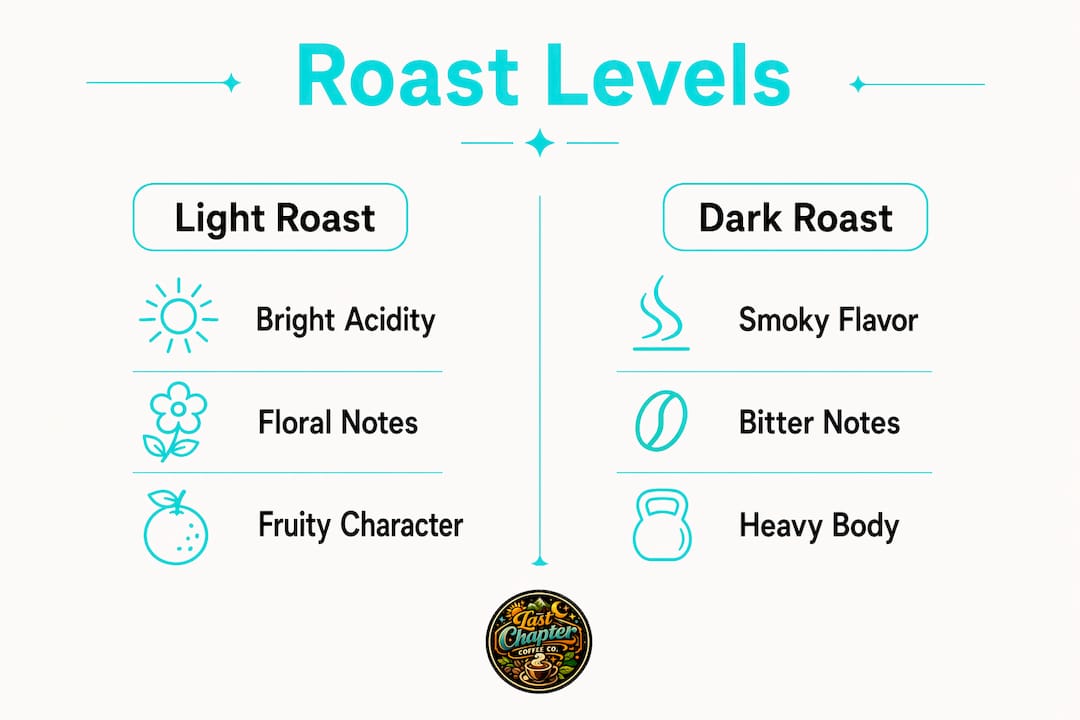
| Roast level | Flavor characteristics | Origin character |
|---|---|---|
| Light | Bright acidity, floral, fruity, tea-like | Strongly preserved |
| Medium | Balanced sweetness, caramel, mild body | Partially preserved |
| Dark | Smoky, bitter, heavy-bodied, cocoa | Largely obscured |
Light roasts stop early, preserving the origin notes that reflect where the bean was grown. An Ethiopian bean roasted light will show jasmine, blueberry, and citrus. Those qualities come from the bean’s terroir, not the roaster’s drum. Medium roasts develop sweetness and complexity by allowing caramelization to proceed further while keeping some origin character intact. The Specialty Coffee Association recognizes roast color as a scientific decision that links process control directly to flavor outcome.
Dark roasts push past the point where origin attributes survive. Smoky, bitter, and heavy-bodied notes dominate because roast-derived compounds overwhelm whatever the green bean brought to the table. Origin flavor and roast flavor exist on an inverse scale. As roasting darkens, origin attributes fade and roast-derived notes take over completely.
First crack is the critical milestone every roaster watches. It occurs when internal bean pressure from steam and CO2 causes an audible pop, signaling that the bean has reached a light roast threshold. Stopping just after first crack produces a balanced, complex cup. Pushing well beyond it moves the profile toward dark roast territory.
Pro Tip: If you want to taste the terroir of a single-origin bean, buy it light-roasted. If you want a consistent, bold espresso blend that holds up under milk, go medium to medium-dark. The roast level is doing more work than the origin label on the bag.
What nuanced factors affect flavor development during roasting?
Roast color and temperature alone do not guarantee great flavor. Several subtler variables shape the final cup in ways that surprise even experienced coffee drinkers.
Moisture content in the green bean regulates when the Maillard reaction begins. Water evaporates at 100°C, and until it does, surface temperature stays capped at that point. This delays the onset of browning reactions. Improper moisture management causes baking defects, producing flat, papery flavor even when the roast color looks correct. A bean that looks medium-roasted can taste underdeveloped if the roaster moved through the drying phase too quickly.
Pre-roast processing also reshapes the flavor potential of the bean before it ever hits the drum. Biomimetic fermentation, a controlled process that mimics natural microbial activity, increases fruity ester compounds by more than threefold at medium roast. Peak fruity ester abundance reaches 112.4 μg/g with fermentation versus 36.5 μg/g in a standard washed control. That difference is not subtle. It shows up clearly in the cup as heightened tropical fruit and floral complexity.
The sweetness you taste in roasted coffee is not from residual sugar. Natural sugars are largely destroyed during roasting. Instead, volatile caramelization products like furaneol create the perception of sweetness. Acidic compounds that mask sweetness decrease by 50–70% at medium roast, allowing that sweetness to peak. This is why medium roasts often taste sweeter than light roasts, even though both have lost most of their original sugar content.
Key nuanced factors that shape flavor development:
- Green bean moisture: Controls when Maillard reactions start; too fast through drying causes baking defects
- Pre-roast fermentation: Biomimetic processing can triple fruity ester concentrations, adding complexity
- Melanoidin buffering: Binds and releases aroma compounds over time, affecting freshness and shelf life
- Acid reduction: Medium roast reduces masking acids, allowing sweetness perception to peak
- Roast color vs. flavor balance: Darker color does not always mean better development; it can mean lost origin character
How can roasting techniques be optimized for desired flavor outcomes?
Roasting technique is where science meets craft. The roast curve, a graph of bean temperature over time, is the primary tool for controlling flavor development. A well-managed curve ensures each reaction pathway gets the time and heat it needs without burning or underdeveloping the bean.
- Control the drying phase. Spend adequate time below 160°C to evaporate moisture evenly. Rushing this phase caps the Maillard reaction before it starts properly.
- Manage the Maillard window. The 140–160°C range is where nutty and roasted notes build. A steady, moderate rate of rise through this zone develops complexity without scorching.
- Watch the first crack. Ending the roast at or just after first crack produces a balanced profile. Extending past it shifts flavor toward roast-derived bitterness and body.
- Avoid crashing the rate of rise. A sudden drop in temperature increase, called a crash, stalls reaction progress and produces flat, baked flavors despite correct color.
- Match the curve to your flavor goal. A faster post-crack development favors brightness and acidity. A slower, extended development builds body and sweetness.
Roasters who ignore individual chemical pathways often produce coffee that looks correct but tastes flat. Time and temperature must be managed together, not just one or the other. Roast color is a useful indicator, but it is not a substitute for understanding what is happening chemically inside the bean.
For those who want to experience the results of precise roast curve management, Lastchaptercoffee’s Italian Roast demonstrates what extended dark roast development produces in terms of body and intensity.
Pro Tip: If your coffee tastes flat or papery despite looking the right color, the problem is almost always in the drying phase. Slow down before 160°C and give moisture time to leave the bean evenly. Color is a lagging indicator. Flavor development happens earlier.
Key takeaways
Roasting is the decisive step in coffee flavor creation, driven by three chemical reactions that must be managed with precision to produce a great-tasting cup.
| Point | Details |
|---|---|
| Three reactions build flavor | Maillard, caramelization, and Strecker degradation each create distinct flavor compounds at specific temperatures. |
| Roast level controls flavor emphasis | Light roasts preserve origin character; dark roasts replace it with roast-derived smoky and bitter notes. |
| Moisture management is critical | Poor drying phase control causes baking defects that flatten flavor regardless of roast color. |
| Sweetness peaks at medium roast | Caramelization products, not residual sugar, create sweetness perception, which peaks when masking acids drop at medium roast. |
| Pre-roast processing multiplies complexity | Biomimetic fermentation can triple fruity ester concentrations, dramatically increasing flavor depth before roasting begins. |
Why roasting is both a science and a decision
I have spent years tasting coffees side by side across roast levels, and the thing that still surprises me is how much roasting is a philosophical choice, not just a technical one. You are deciding what story the coffee tells. A light roast says, “Here is where this bean came from.” A dark roast says, “Here is what heat and time can build.” Neither is wrong. They are just different conversations.
What I find most underappreciated is the moisture phase. Every roaster talks about first crack and development time. Almost no one talks about what happens in the first two minutes. That is where the foundation is laid. Get the drying phase wrong and nothing you do afterward fixes it. The Maillard reaction cannot start properly on a bean that still holds uneven moisture. You end up with a cup that looks roasted but tastes hollow.
The chemistry also reframes how I think about buying coffee. When I see a medium roast from a well-processed Ethiopian bean, I know I am getting both origin complexity and caramelization-driven sweetness. That combination is genuinely hard to achieve. It requires the roaster to understand the inverse relationship between origin character and roast development, and to stop at exactly the right moment. That is a skill worth paying for.
Consumer preferences are pushing roasters toward lighter profiles right now, and I think that is mostly good. It forces roasters to actually understand their green beans rather than hiding defects under dark roast bitterness. But the best roasters I know work across the full spectrum. They know when to let the bean speak and when to let the drum do the talking.
— Rogee
Lastchaptercoffee’s roasted blends worth tasting
Roasting expertise shows up most clearly when you taste coffees across different roast levels from the same source.
Lastchaptercoffee curates blends that demonstrate exactly what thoughtful roasting produces at each level. The African Kahawa Blend is a strong starting point. It is a balanced medium roast that captures both the fruity, floral origin character of African beans and the caramelization-driven sweetness that medium roasting unlocks. For those drawn to the heavier end of the spectrum, the Coffee with Mushrooms Dark Roast shows what extended roast development builds in terms of body and depth. Every blend ships free within the US, so tasting the difference across roast levels costs nothing extra.
FAQ
What is the role of roasting in coffee flavor?
Roasting triggers the Maillard reaction, caramelization, and Strecker degradation, converting raw green beans into a beverage with hundreds of flavor-active compounds. Without roasting, coffee has almost no aroma or taste.
How does roast level change the flavor of coffee?
Light roasts preserve origin notes like fruit and florals, while dark roasts replace them with smoky, bitter, and heavy-bodied flavors driven by roast-derived compounds. Roast level is the single most critical factor in flavor determination.
Why does medium roast coffee taste sweeter than light roast?
Sweetness in roasted coffee comes from volatile caramelization products like furaneol, not residual sugar. At medium roast, masking acids decrease by 50–70%, allowing sweetness perception to peak.
What causes flat or papery flavor in roasted coffee?
Flat flavor is almost always caused by improper moisture management in the early roasting phase. If the bean does not dry evenly before 160°C, the Maillard reaction starts poorly and produces underdeveloped flavor despite correct roast color.
Can pre-roast processing improve coffee flavor?
Yes. Biomimetic fermentation before roasting triples fruity ester concentrations at medium roast, producing measurably greater flavor complexity compared to standard washed processing.


