

The type of coffee grinder you use determines your brew quality more than almost any other variable, and burr grinders are the clear standard for consistent, flavorful results. The three main coffee grinder types are electric burr grinders, blade grinders, and manual burr grinders. Each works differently, produces different particle sizes, and suits different brewing situations. Brands like Fellow Opus, Baratza Encore, and Oxo have made quality burr grinding accessible at home. This guide breaks down every type so you can match the right grinder to your brewing method, budget, and daily routine.
1. Electric burr grinders: the gold standard for home brewing
Electric burr grinders are the most recommended coffee grinder type for home use, and for good reason. They work by crushing beans between two abrasive surfaces, producing a uniform particle size that leads to better, more predictable extraction. Serious Eats tested 19 grinders and consistently favored electric burr grinders for their flavor output and repeatability across brew methods.
Within electric burr grinders, you have two distinct subtypes: conical burr and flat burr. Understanding the difference matters because each produces a different flavor profile in your cup.
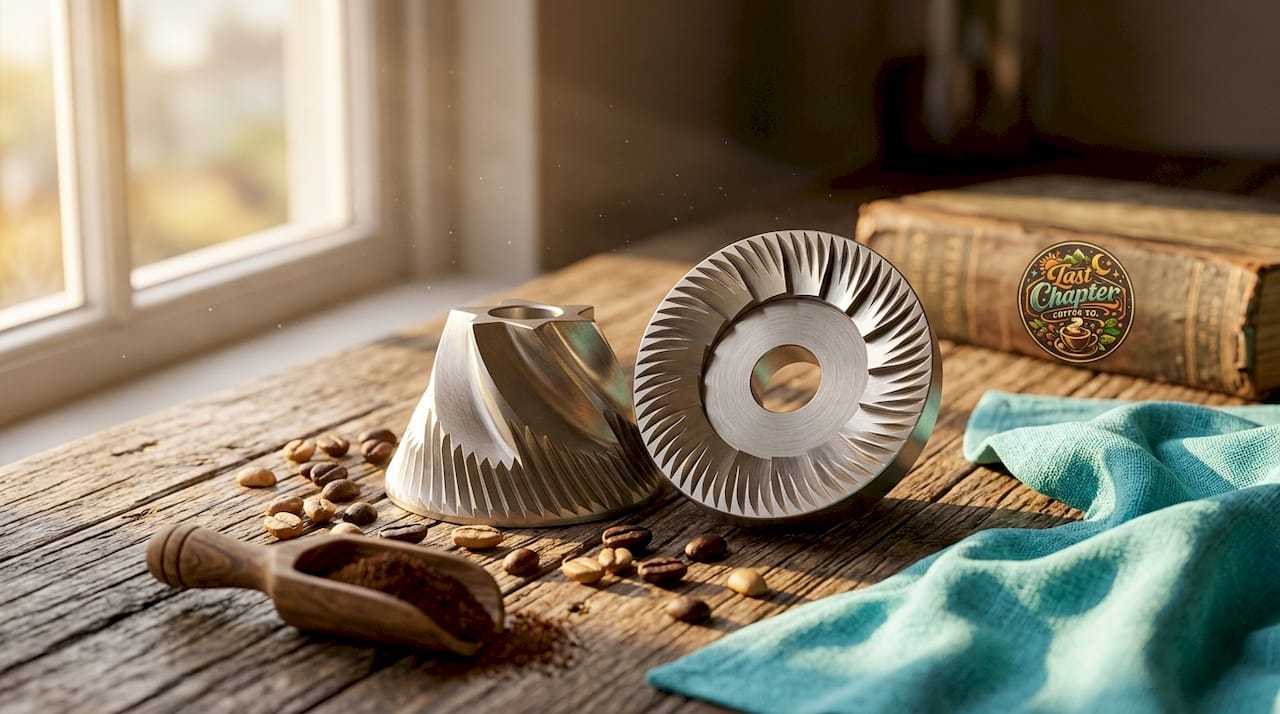
Conical vs. flat burr grinders
Conical burrs produce a bimodal particle distribution with more fine particles, which adds body, sweetness, and a rounded flavor. Flat burrs create a unimodal, more uniform grind that delivers clarity and flavor separation. Think of it this way: conical burrs blend flavors together into a rich, full cup, while flat burrs let individual tasting notes stand apart.
Flat burr grinders require precise alignment and higher RPM motors, making them more expensive and harder to maintain than conical models. Conical burrs run slower, generate less heat, and are largely self-aligning, which makes them the more practical choice for most home setups. The Baratza Encore and Fellow Opus both use conical burrs and represent the sweet spot between price and performance.
| Feature | Conical burr | Flat burr |
|---|---|---|
| Grind profile | Bimodal, more fines | Unimodal, uniform |
| Flavor result | Rich body, sweetness | Clarity, flavor separation |
| Heat generation | Lower | Higher |
| Maintenance | Easier, self-aligning | Requires precise alignment |
| Price range | $50 to $300+ | $200 to $1,000+ |
Pro Tip: If you brew mostly espresso and want clean, distinct flavors, a flat burr grinder is worth the investment. For everything else, a conical burr grinder handles the job with less fuss and lower cost.
2. Blade coffee grinders: what you need to know before buying
Blade grinders are the most common entry-level option, but they are not true grinders in the technical sense. They operate more like blenders or spice choppers, spinning a metal blade to chop beans into uneven fragments. The result is a chaotic mix of fine dust and large chunks in the same batch.
That inconsistency has a direct impact on flavor. Uneven particle size causes simultaneous under- and over-extraction, producing a cup that tastes both sour and bitter at the same time. Most people blame the beans when the real culprit is the grinder. Beyond particle inconsistency, blade grinders generate more friction heat during operation, which degrades volatile aroma compounds before the water even touches the grounds.
Where blade grinders do make sense:
- Very casual drinkers who brew basic drip coffee once or twice a week
- Households that need a dual-purpose device for grinding spices
- Situations where budget is the absolute top priority and flavor precision is not
Pro Tip: If you already own a blade grinder, pulse it in short bursts and shake the chamber between pulses. This does not fix the inconsistency problem, but it reduces the worst of the uneven chopping.
Blade grinders are not recommended for espresso, pour-over, or any method where grind precision drives the outcome. For those methods, even a budget manual burr grinder outperforms a blade grinder at a similar price point.
3. Manual coffee grinders: high quality without the power cord
Manual coffee grinders use the same burr grinding mechanism as electric models, but you supply the power by turning a hand crank. Most manual grinders use conical steel burrs, and the grind quality they produce is genuinely comparable to entry-level electric burr grinders.
Manual burr grinders like the KINGrinder K6 and Timemore C2 outperform blade grinders and serve as excellent first upgrades for anyone moving away from blade grinding. They cost less than most electric burr grinders, take up minimal counter space, and travel well. For campers, remote workers, or anyone who wants a quiet morning grind without waking the household, a manual grinder is a practical and satisfying tool.
Who benefits most from manual grinders:
- Home brewers on a budget who still want burr grind quality
- Travelers and campers who need a compact, battery-free option
- Pour-over enthusiasts who enjoy the ritual of hand grinding
- Anyone brewing small single-serve batches daily
The main trade-off is time and effort. Grinding enough for a single espresso shot takes about 30 to 60 seconds of steady cranking. A full French press dose can take two to three minutes. That effort is a feature for some people and a dealbreaker for others.
Pro Tip: The Timemore C2 is one of the best value manual grinders available. Its stainless steel burrs and stepless adjustment give you grind precision that rivals electric grinders costing three times as much.
4. How grind size connects to your brewing method
The role of grind size in brewing is not a minor detail. It is the variable that controls how fast water moves through the grounds, how much surface area is exposed, and how many flavor compounds dissolve into your cup. Every brewing method has an optimal particle size range, and your grinder type determines whether you can hit that range consistently.
Here is a practical coffee grind size guide mapped to common brew methods:
| Brew method | Grind size | Approximate particle size | Brew time |
|---|---|---|---|
| Cold brew | Extra coarse | 1,000+ microns | 12 to 24 hours |
| French press | Coarse | 800 to 1,000 microns | 4 to 6 minutes |
| Drip coffee | Medium | 500 to 700 microns | 4 to 6 minutes |
| Pour-over | Medium fine | 400 to 600 microns | 2 to 4 minutes |
| Espresso | Fine | 200 to 400 microns | 25 to 30 seconds |
Espresso targets a particle size of 200 to 400 microns, and deviating from that range causes sourness from under-extraction or bitterness from over-extraction. Grind consistency is more than average particle size. The breadth of the distribution matters just as much. A wide spread of particle sizes causes uneven water flow through the puck, leading to channeling and a muddy, conflicted flavor even when the average grind size looks correct on paper.
Coarse grinds suit French press and cold brew because their long immersion times extract flavor slowly. A fine grind in a French press would over-extract in minutes and leave excessive silt in the cup. Burr grinders let you dial in a specific setting and repeat it every time. Blade grinders cannot do this. Their output varies batch to batch, which is why they are mostly limited to basic drip coffee where the margin for error is widest.
For anyone brewing African espresso or specialty pour-overs, a burr grinder is not optional. The flavor complexity in high-quality beans only shows up when extraction is even and controlled.
Key takeaways
The grinder you choose shapes every cup you brew, and burr grinders at every price point outperform blade grinders in consistency, flavor, and versatility.
| Point | Details |
|---|---|
| Burr grinders outperform blade grinders | Burr grinders crush beans evenly, producing consistent particle sizes for better extraction. |
| Conical vs. flat burrs affect flavor | Conical burrs add body and sweetness; flat burrs deliver clarity and flavor separation. |
| Manual grinders offer real value | Models like the KINGrinder K6 and Timemore C2 match entry-level electric burr quality at lower cost. |
| Grind size must match brew method | Espresso needs 200 to 400 microns; French press and cold brew need coarse to extra-coarse grinds. |
| Blade grinders limit your brewing | Uneven particle distribution causes simultaneous sour and bitter notes, regardless of bean quality. |
Why I stopped recommending blade grinders entirely
I spent years telling casual coffee drinkers that a blade grinder was “fine for now.” I was wrong. The problem is not just that blade grinders produce inconsistent grinds. The deeper issue is that they make it impossible to diagnose your coffee. When a cup tastes off, you cannot tell if the problem is the beans, the water temperature, the brew ratio, or the grind. With a burr grinder, you eliminate one major variable. That clarity changes how you learn to brew.
My personal recommendation for anyone starting out is the Baratza Encore. It is not the cheapest option, but it handles every brew method from French press to pour-over without adjustment drama. If budget is tight, the Timemore C2 manual grinder gets you 80% of the way there for a fraction of the price. The Fellow Opus is worth considering if you want one grinder that covers both espresso and filter brewing without buying two separate machines.
The one thing I would tell every home brewer is this: stepless grind adjustment beats stepped adjustment for espresso. Stepped grinders lock you into fixed settings, and espresso is sensitive enough that the gap between two steps can mean the difference between a great shot and a sour one. For filter brewing, stepped adjustment is perfectly fine.
Blade grinders have one legitimate use case: grinding spices. For coffee, they belong in a different drawer.
— Rogee
Explore the blends that reward a great grinder
A quality burr grinder only performs at its best when paired with coffee worth grinding. At Lastchaptercoffee, every blend is roasted to order and shipped free across the US, so the beans arrive fresh and ready to perform. The African Kahawa Blend is a standout choice for pour-over and filter brewing, with the kind of layered flavor that only shows up when your grind is consistent. For espresso lovers, the Max Caf Blend is built for pressure extraction and rewards the precision that a flat or conical burr grinder delivers. Cold brew fans can start with the Cold Brew Coffee blend, ground coarse and steeped overnight for a smooth, low-acid result.
FAQ
What is the best type of coffee grinder for home use?
Burr grinders are the best choice for home use because they produce consistent particle sizes that lead to better extraction and flavor. The Baratza Encore and Fellow Opus are two of the most recommended models for home brewers.
What is the difference between conical and flat burr grinders?
Conical burrs produce a bimodal grind with more fines, adding body and sweetness to the cup. Flat burrs create a uniform, unimodal grind that delivers cleaner flavor separation and clarity.
Can a blade grinder produce good coffee?
Blade grinders produce uneven particle sizes that cause simultaneous under- and over-extraction, resulting in cups that taste both sour and bitter. They are not recommended for any brew method that requires grind precision.
Are manual coffee grinders worth buying?
Manual burr grinders like the KINGrinder K6 and Timemore C2 deliver grind quality comparable to entry-level electric burr grinders at a lower price. They are an excellent choice for travelers, single-serve brewers, and anyone on a tight budget.
What grind size should I use for espresso?
Espresso requires a fine grind targeting 200 to 400 microns. Outside that range, extraction becomes uneven, producing sourness from under-extraction or bitterness from over-extraction.


