

Coffee bean density is defined as a bean’s mass divided by its volume, typically measured in grams per liter (g/L), and it directly determines how a bean roasts, extracts, and tastes in your cup. Specialty coffee professionals classify beans above 680 g/L as standard density, with high-density beans exceeding 720 g/L. That number is not just a lab figure. It tells you how compact the bean’s cellular structure is, which shapes everything from roast time to the sweetness you taste in the final brew. For home brewers, understanding coffee bean density explained in practical terms is the difference between guessing at your grinder settings and actually knowing why one bag tastes brighter than another.
What is coffee bean density and why does it matter?
Coffee bean density measures how much mass is packed into a given volume of bean. A dense bean has tightly packed cell walls, less air space, and more dry matter per unit of volume. A less dense bean has looser cellular structure, often the result of faster cherry maturation at lower altitudes or in warmer climates.
The industry standard unit is grams per liter (g/L) for green coffee. Specialty coffee thresholds place the cutoff at 680 g/L, with premium lots often landing between 720 and 780 g/L. Beans below 680 g/L are considered low density and behave very differently under heat. That range of roughly 100 g/L separates a bean that needs careful, sustained heat from one that roasts quickly and unevenly if you are not paying attention.
Density also connects directly to flavor. Denser beans tend to carry more sugars and organic acids locked inside their compact structure, which translates to greater sweetness and complexity in the cup. This is why Ethiopian and Colombian lots often taste more layered than lower-altitude coffees grown in similar conditions but at faster maturation speeds.
How altitude and origin shape coffee bean density
The single biggest driver of bean density is growing altitude. At higher elevations, cooler temperatures slow the maturation of the coffee cherry. That slower development gives the seed more time to accumulate dry matter, resulting in a denser, more structurally compact bean.
High-altitude coffees like Ethiopian and Colombian beans typically measure between 710 and 780 g/L. Sumatran coffees, grown at lower elevations and processed through wet-hulling, commonly fall between 650 and 710 g/L. Brazilian naturals, often grown on flat plateaus at moderate altitudes, sit toward the lower end of the specialty range. That gap in density explains a lot of the flavor difference you notice between a bright Ethiopian Yirgacheffe and a smooth, low-acid Brazilian Santos.
Here is a quick comparison of typical density ranges by origin:
| Origin | Altitude range | Typical density (g/L) | Flavor character |
|---|---|---|---|
| Ethiopia (Yirgacheffe) | 1,800–2,200 m | 730–780 | Floral, bright acidity, complex |
| Colombia (Huila) | 1,500–2,000 m | 710–750 | Balanced, sweet, fruity |
| Brazil (Cerrado) | 800–1,200 m | 660–700 | Smooth, nutty, low acidity |
| Sumatra (Mandheling) | 1,000–1,500 m | 650–710 | Earthy, full body, low brightness |
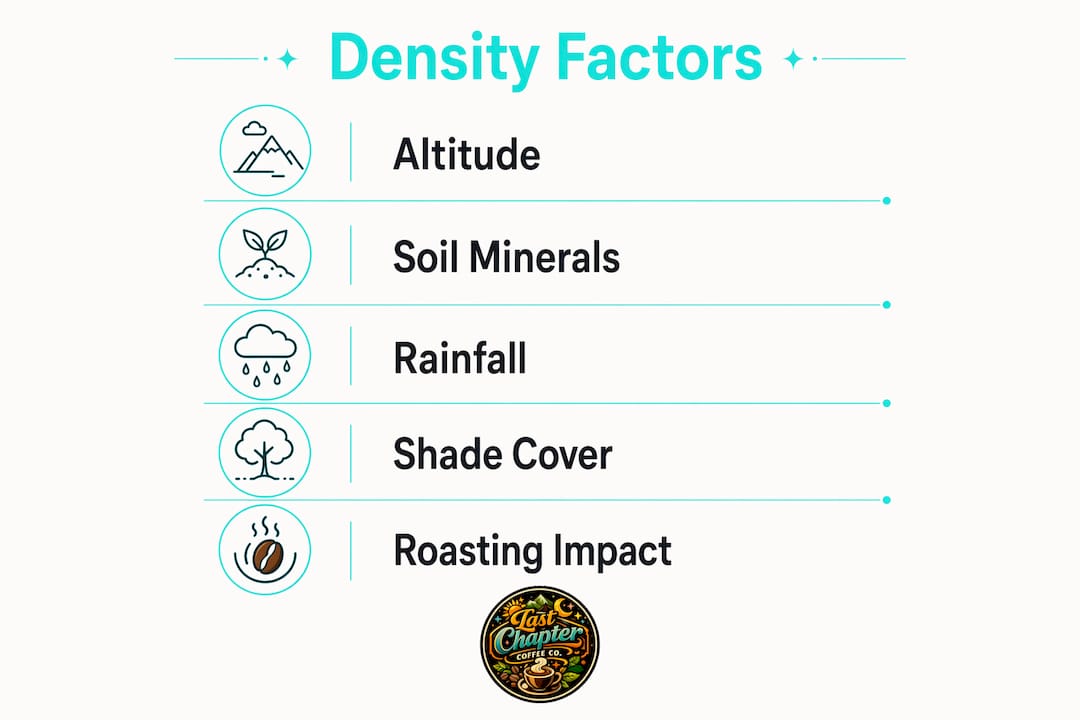
Beyond altitude, soil mineral content, rainfall patterns, and shade cover all influence how dense a bean becomes. Density differences among origins explain some of the variation in cup profiles, but moisture content and processing method also play significant roles. A washed Ethiopian and a natural Ethiopian from the same farm can show measurable density differences because the drying process affects moisture retention.
How to measure coffee bean density at home
Measuring coffee bean density accurately requires two tools: a kitchen scale and a graduated cylinder or measuring cup. The process is straightforward.
- Weigh your beans. Use a precise scale and measure out 100 grams of green coffee beans.
- Measure the volume. Pour the beans into a graduated cylinder or a clear measuring cup and record the volume in milliliters.
- Calculate density. Divide the weight (in grams) by the volume (in milliliters) to get g/mL, or multiply by 1,000 to convert to g/L.
- Repeat for consistency. Run the measurement three times and average the results to account for how beans settle differently each pour.
- Keep conditions stable. Measure beans at room temperature and avoid doing this right after opening a bag, since moisture exposure can shift the reading slightly.
Density is mass divided by volume, and this simple calculation gives you a reliable baseline for any green coffee lot. For roasted beans, the same method applies, but expect significantly lower numbers since roasting causes beans to expand and lose moisture.
A floatation test offers a rougher estimate. Drop beans into water: denser beans sink faster, while less dense beans float or sink slowly. This method does not give you a number, but it quickly separates a high-density lot from a low-density one when you are comparing two bags side by side.
Pro Tip: Always use the same container and the same pouring technique for every measurement. Tapping the cylinder to settle beans before reading the volume reduces variability and gives you a more repeatable result.
How does bean density affect roasting and flavor development?
Density is one of the most important variables a roaster manages, and its effects go beyond simply needing more heat. Denser beans require higher charge temperatures and longer development times to achieve even heat penetration through the compact cellular structure. A roaster who treats a 750 g/L Ethiopian the same way they treat a 670 g/L Brazilian will get uneven results: underdeveloped centers, inconsistent color, and a flat flavor profile.
The mechanism is worth understanding. Density affects roast momentum rather than just the initial heat charge. A dense bean absorbs energy more slowly at first, then accelerates through the Maillard reaction phase differently than a lighter bean. This means roasters need to read the entire roast curve, not just set a higher starting temperature and walk away.
Lower-density beans heat faster and reach first crack sooner. That speed creates a risk of scorching the surface before the interior develops properly. Careful heat management, often involving a lower charge temperature and a slower ramp rate, compensates for this.
“Density should not be viewed as a standalone quality metric but as a pivotal roasting variable to guide consistent heat application.” — Le Brew Tech
There is also an important nuance about quality. Denser beans are often sweeter and more structurally sound, but density alone does not guarantee cup quality. A high-density bean that is poorly processed or incorrectly roasted will still disappoint. Density tells you how to approach the roast. It does not guarantee the outcome.
Roasting also changes density permanently. Physical changes during roasting cause a significant drop in bean density as moisture escapes and the bean expands. A green bean at 730 g/L might measure closer to 400 to 500 g/L after a medium roast. This is why density measurements for roasted coffee are always lower than green coffee benchmarks.
What coffee bean density means for your home brewing
For home brewers, the practical impact of density shows up in two places: dosing and extraction behavior. A denser bean packs more dry matter into the same physical space, which means a scoop-based dose gives you a different amount of coffee than it would with a lighter bean. Weighing your dose rather than scooping by volume removes this variable entirely.
Extraction also responds to density. Denser beans tend to yield a more concentrated extraction at the same grind setting and brew ratio, because more soluble material is available per gram of coffee. If you switch from a low-altitude Brazilian to a high-altitude Colombian and keep everything else the same, your cup will likely taste stronger and more acidic. Adjusting your grind slightly coarser or reducing your dose by a gram or two brings it back into balance.
Here is how density awareness translates to practical brewing adjustments:
| Bean density | Brewing behavior | Suggested adjustment |
|---|---|---|
| High (720+ g/L) | Stronger extraction, brighter acidity | Grind slightly coarser or reduce dose |
| Medium (680–720 g/L) | Balanced extraction | Use standard recipe as baseline |
| Low (below 680 g/L) | Lighter extraction, softer body | Grind slightly finer or increase dose |
One limitation worth knowing: ground coffee density changes based on burr geometry and particle size, so the density of your whole beans does not directly predict the density of your grounds. A flat burr grinder and a conical burr grinder produce different particle distributions from the same bean, which affects how the grounds pack and how water flows through them. This is why grind size and burr type significantly impact dosing and extraction consistency, even when the source bean is identical.
You can explore how these density differences play out across origins by browsing coffees by origin at Lastchaptercoffee, where single-origin and blend options reflect a range of growing altitudes and density profiles.
Key takeaways
Coffee bean density is the single most underused variable in home brewing, and understanding it closes the gap between inconsistent results and repeatable, flavorful cups.
| Point | Details |
|---|---|
| Density defined | Mass divided by volume in g/L; specialty threshold starts at 680 g/L. |
| Altitude drives density | Ethiopian and Colombian beans reach 710–780 g/L; Brazilian and Sumatran beans typically fall below 710 g/L. |
| Roasting impact | Denser beans need longer development and higher charge temps; density shapes roast momentum, not just starting heat. |
| Brewing adjustment | High-density beans extract more intensely; grind coarser or reduce dose when switching to denser lots. |
| Density is not quality | High density indicates favorable growing conditions but does not guarantee cup quality without proper roasting and processing. |
Why density changed how I think about every bag I open
I spent years treating coffee bags as interchangeable. Same grinder setting, same dose, same brew time. The results were wildly inconsistent, and I blamed my equipment. Then I started paying attention to where my beans were grown and at what altitude, and the inconsistency suddenly made sense.
The first time I measured two bags side by side, a washed Ethiopian Guji and a natural Brazilian, the density difference was around 80 g/L. That gap explained why my Ethiopian always tasted thin and over-extracted at my standard recipe while the Brazilian tasted flat and dull. I was brewing both the same way, but they needed completely different approaches.
What I have found is that most home brewers skip density because it sounds technical. It is not. It is just a number that tells you how hard the bean will push back against your grinder and your hot water. Once you know that number, or even just know whether your bean is high or low altitude, you can make smarter adjustments without guessing.
The mistake I see most often is treating density as a quality score. A 750 g/L bean is not automatically better than a 680 g/L bean. It is just different, and it needs to be handled differently. The Brazilian naturals I have loved most were all on the lower end of the density scale. They were sweet, smooth, and perfectly suited to a slower, lower-temperature brew. Density told me how to get there.
My advice: start by noting the origin and altitude on every bag you buy. High altitude almost always means higher density. From there, adjust your grind and dose based on how the cup tastes, not just how the recipe reads. Combine that with attention to roast level and processing method, and you will get more out of every bag than you thought possible.
— Rogee
Taste the difference that density makes

At Lastchaptercoffee, the sourcing philosophy starts with beans that have something to say. The African Kahawa Blend draws on high-altitude African lots with density profiles that push well above the 720 g/L specialty threshold, delivering the layered sweetness and bright acidity that only compact cellular structure can produce. The African Espresso takes those same dense beans and develops them through a roast profile calibrated specifically for their heat absorption characteristics. Every order ships free within the US, so you can taste exactly what density-informed roasting produces in your own cup.
FAQ
What is the normal density range for coffee beans?
Green specialty coffee beans typically range from 680 to 780 g/L. Beans above 720 g/L are considered high density, while those below 680 g/L fall into the low-density category.
Does roasting change coffee bean density?
Yes. Roasting causes beans to expand and lose moisture, which significantly reduces density. A green bean measuring 730 g/L can drop to roughly 400 to 500 g/L after a medium roast.
How does bean density affect grind settings?
Denser beans extract more intensely at the same grind size, so switching to a higher-density lot often requires a slightly coarser grind or a reduced dose to maintain balance. Ground coffee density also varies by burr type, so results differ across grinder models.
Can I measure coffee bean density at home?
Yes. Weigh 100 grams of green beans, pour them into a graduated cylinder, record the volume in milliliters, and divide weight by volume to get g/mL. Multiply by 1,000 to convert to g/L.
Does higher density always mean better coffee?
No. Density indicates growing conditions more than absolute quality. A high-density bean that is poorly processed or incorrectly roasted will still produce a disappointing cup. Density is a roasting guide, not a quality guarantee.


