

Coffee terroir is defined as the combined influence of climate, altitude, soil, rainfall, and surrounding ecosystems on how a coffee plant grows and what flavors its beans develop. The concept, borrowed from wine, has taken on new scientific weight in specialty coffee. Recent research from Minas Gerais, Brazil confirms that terroir shapes measurable chemical compounds including chlorogenic acids, lipids, and sugars, not just subjective tasting notes. Understanding coffee terroir gives you a reliable framework for predicting what a cup will taste like before you ever brew it.
What is coffee terroir and why does it matter?
Coffee terroir is best understood as the total environmental fingerprint left on a coffee bean from seed to harvest. No single factor defines it. Climate, altitude, soil composition, rainfall patterns, and the surrounding ecosystem all work together to set the flavor ceiling for any given lot of coffee.
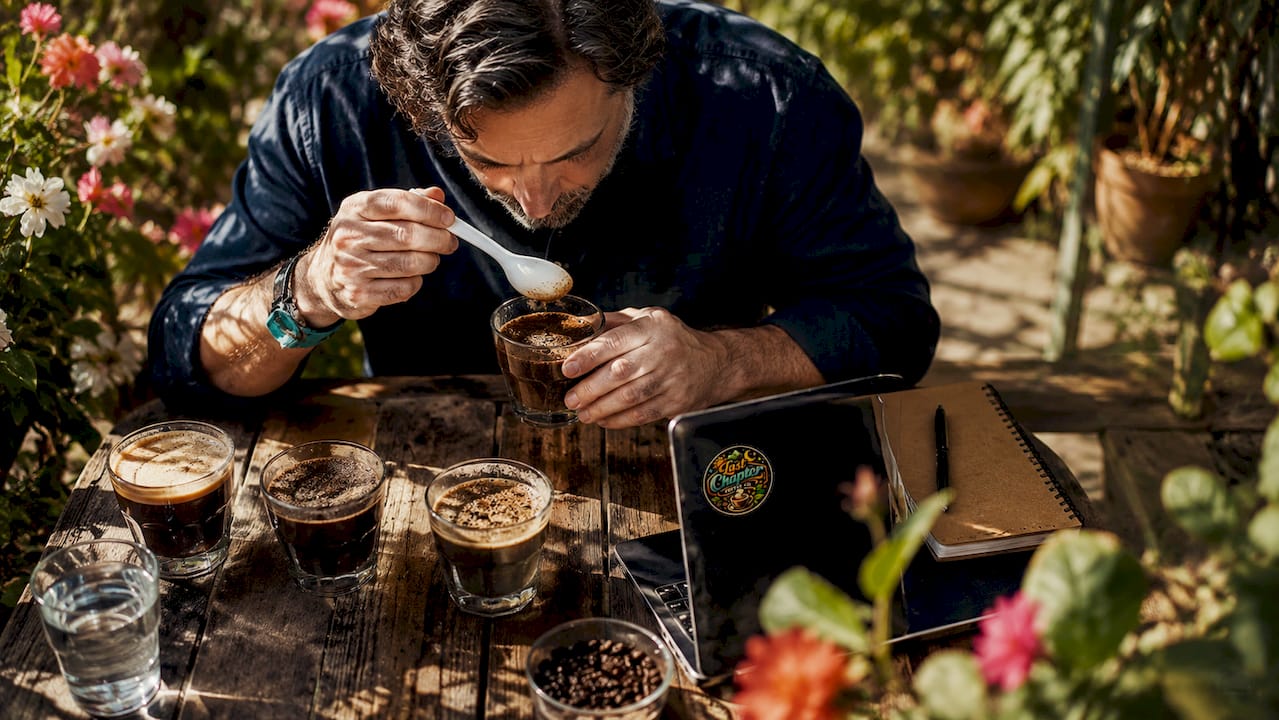
The concept matters because it explains why two coffees grown from the same varietal can taste completely different. A Bourbon varietal grown in Rwanda’s volcanic highlands will taste nothing like the same Bourbon grown in a low-altitude farm in Honduras. Terroir is the reason.
Specialty coffee professionals treat terroir as context, not a guarantee. It sets the range of possible flavors, while processing and roasting determine which of those possibilities end up in your cup.
Which environmental factors shape coffee terroir?
Each element of terroir plays a distinct role. They rarely act in isolation. The most interesting flavors come from regions where multiple factors align in unusual ways.
Climate and rainfall
Temperature patterns and rainfall timing control when coffee flowers and how long cherries take to ripen. Slow, even ripening under mild temperatures allows more sugars to accumulate in the cherry. Erratic rainfall or temperature swings compress that window, producing thinner, less complex beans.
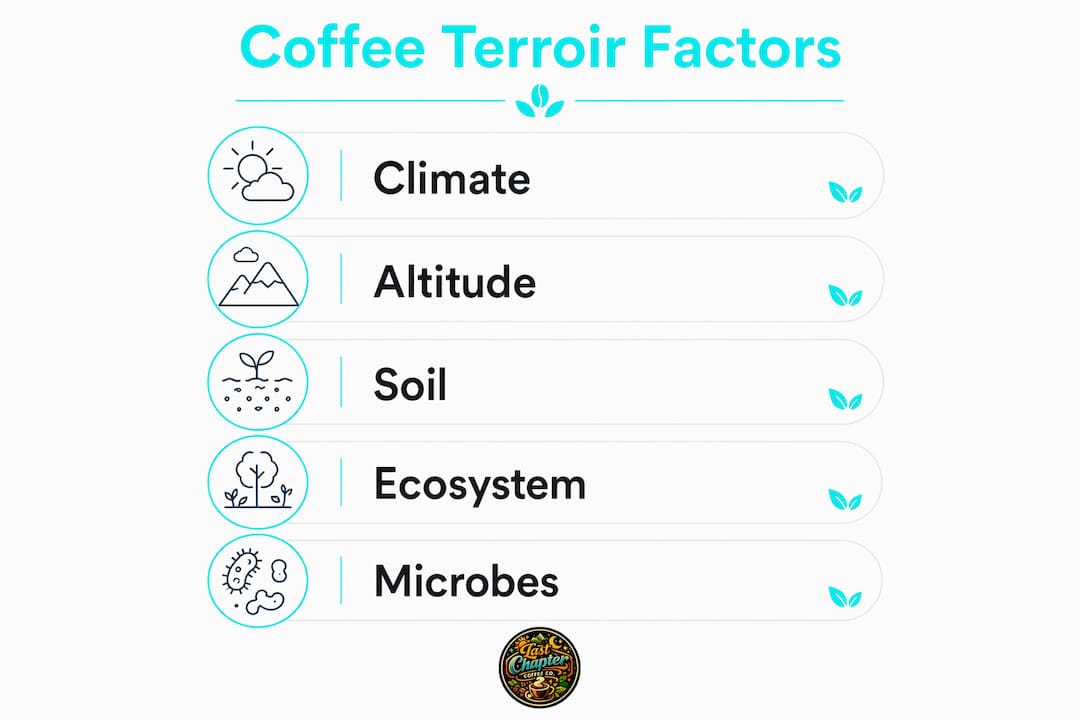
Humidity also affects the microbial environment surrounding the plant, which feeds directly into fermentation behavior after harvest.
Altitude
Higher altitude slows maturation, building complexity by giving the bean more time to develop sugars and organic acids. The result is denser beans with higher perceived acidity and more layered flavor. Excessive altitude introduces frost risk and potential defects, so the sweet spot varies by region.
Ethiopia’s Yirgacheffe, grown at elevations above 6,000 feet, is a textbook example. Its floral and citrus notes come directly from the combination of altitude, temperature, and the specific microbial environment of that region.
Soil composition
Soil texture and microbial life contribute to terroir beyond simple geography. Volcanic soils, common in Guatemala and Indonesia, are rich in minerals that influence nutrient absorption and flavor precursors in the bean. Sandy or clay-heavy soils drain differently, affecting root health and water uptake.
The microbiota living in the soil also interact with root systems in ways that are still being studied. What is clear is that soil type correlates with measurable differences in bean chemistry.
Surrounding ecosystem
Flora, fauna, and local farming practices create micro-regional flavor uniqueness that even neighboring farms cannot replicate. Shade trees affect temperature and humidity. Native plants introduce organic matter into the soil. Even the insects and birds present on a farm influence the ecosystem in ways that eventually show up in the cup.
Pro Tip: When reading a coffee bag, look for ecosystem notes like “shade-grown” or “forest-adjacent.” These signal a richer microbial environment and often predict more complex flavor development.
| Terroir Factor | Primary Influence | Flavor Impact |
|---|---|---|
| Altitude | Slows ripening, increases density | Higher acidity, more complexity |
| Soil composition | Mineral and microbial availability | Flavor precursor development |
| Climate and rainfall | Cherry maturation timing | Sugar accumulation, body |
| Surrounding ecosystem | Microbial and organic environment | Fermentation character, uniqueness |
What does science say about terroir’s impact on coffee?
The science behind terroir’s role in coffee has moved well beyond sensory panels. A 2026 Springer Nature study examining Coffea arabica grown across different regions of Minas Gerais, Brazil found that terroir modulates acidity, body, and quality in ways that correlate directly with chemical markers. Chlorogenic acids, lipids, trigonelline, and sugars all varied by growing region. That variation is not random. It maps to specific environmental conditions.
Sensory professionals now use spectroscopy and sensory analysis together to link place to chemistry. This approach enables objective quality certification and origin traceability, moving the industry past “it tastes like blueberries” into verifiable science.
Microbial terroir: the hidden layer
Microbial terroir is the most recent and arguably most fascinating extension of the concept. Research published in Springer Nature found that distinct Brazilian biomes show unique microbial profiles during coffee fermentation. Those microbial communities drive flavor differences that cannot be explained by climate or altitude alone.
This matters practically. Producers working in different biomes cannot simply copy fermentation protocols from other regions and expect the same results. The local microbial ecosystem limits what is replicable. That is why a natural-processed coffee from Bahia tastes different from a natural-processed coffee from Minas Gerais, even when the varietal and method are identical.
| Chemical Compound | Role in Coffee | Terroir Connection |
|---|---|---|
| Chlorogenic acids | Perceived acidity and bitterness | Vary by region and altitude |
| Lipids | Body and mouthfeel | Influenced by soil and climate |
| Trigonelline | Roasted, slightly bitter notes | Affected by maturation speed |
| Sugars | Sweetness and fermentation base | Build during slow ripening |
Pro Tip: If a roaster lists a specific municipality or micro-region on the bag rather than just the country, that precision signals they are tracking terroir at a meaningful level. It is worth paying attention to.
How does terroir differ from processing, roasting, and varietals?
Terroir sets the foundational stage for flavor, while processing and roasting either express or mask that potential. Understanding the difference helps you make smarter decisions when selecting coffee.
Think of terroir as the raw material and everything that follows as the manufacturing process. A coffee with extraordinary terroir can be ruined by poor processing or over-roasting. A coffee with modest terroir can be improved by skilled handling, but it cannot exceed what the environment provided.
Here is how each factor operates:
- Terroir sets the chemical and sensory ceiling. It determines the range of possible flavors.
- Varietals provide the genetic baseline. Gesha and Typica express terroir differently even in the same location.
- Processing methods (washed, natural, honey) determine how much of the fruit’s character transfers to the bean. Natural processing amplifies terroir fruit notes; washed processing clarifies them.
- Roasting is the final modifier. Light roasts preserve terroir-driven acidity and floral notes. Dark roasts like Lastchaptercoffee’s French Roast shift the profile toward roast character, which can reduce terroir expression.
- Brewing controls extraction. Under-extraction mutes complexity; proper extraction lets terroir shine.
Pro Tip: Check the altitude listed on a coffee bag. Beans grown above 4,500 feet typically deliver higher acidity and more flavor complexity. Beans below 3,000 feet tend toward softer, chocolatey, or nutty profiles. Altitude is the single fastest shortcut to anticipating a coffee’s flavor direction.
How can you explore and taste coffee terroir?
Tasting terroir is a skill that builds with deliberate practice. You do not need a professional palate to start. You need a method and some curiosity.
Follow these steps to develop your terroir awareness:
- Start with single-origin coffees. Blends mix terroirs, which makes it harder to isolate regional character. Single-origin coffees from places like Peru or Bali give you a cleaner signal. Lastchaptercoffee’s Peru Coffee Pods are a practical starting point for exploring South American terroir.
- Read the origin details. Country alone tells you little. Look for region, altitude, and processing method. A coffee labeled “Ethiopia, Yirgacheffe, 6,200 ft, washed” gives you enough information to form expectations before you taste.
- Brew consistently. Use the same brewing method and parameters across different origins so the only variable is the coffee itself. A pour-over at a consistent ratio isolates terroir expression better than switching between espresso and French press.
- Taste side by side. Brew two coffees from different regions on the same day. The contrast makes terroir differences obvious in ways that sequential tasting cannot.
- Take notes on acidity, body, and finish. These three attributes are the most directly shaped by terroir variables like altitude, soil, and climate. You will start to recognize patterns across regions.
- Experiment with a sample pack. Lastchaptercoffee’s flavored coffees sample pack lets you taste across multiple profiles without committing to full bags.
The goal is not to memorize flavor maps. The goal is to build a personal reference library so that origin information becomes genuinely predictive for you.
Key takeaways
Coffee terroir is the environmental foundation that sets every coffee’s flavor potential before processing, roasting, or brewing ever begins.
| Point | Details |
|---|---|
| Terroir is multi-factor | Climate, altitude, soil, and ecosystem work together to shape bean chemistry and flavor. |
| Science confirms the impact | A 2026 Springer Nature study links terroir to measurable compounds including chlorogenic acids and sugars. |
| Microbial terroir is real | Local fermentation microbiomes vary by biome and drive flavor differences that geography alone cannot explain. |
| Terroir sets the ceiling | Processing and roasting express or limit terroir potential but cannot create flavors the environment did not provide. |
| Altitude is your fastest shortcut | Beans above 4,500 feet reliably deliver higher acidity and complexity; use altitude labels to anticipate flavor direction. |
Terroir is a story, not a specification
I have tasted coffees from farms less than five miles apart that had nothing in common in the cup. One was bright and citrus-forward; the other was earthy and full-bodied. Same varietal, same processing method, same roaster. The only explanation was the land itself.
That experience changed how I think about terroir. Most coffee writing treats it as a checklist: altitude, soil, rainfall. But the microbial research coming out of Brazil right now suggests terroir is far more dynamic than that. The fermentation microbiome on a farm in the Cerrado is genuinely different from one in the Atlantic Forest, and those differences are not controllable or reproducible. They are local. They are alive.
My honest advice: do not get so deep into the science that you stop enjoying the cup. Terroir knowledge is most useful as a starting hypothesis, not a verdict. You read the origin, you form an expectation, and then you let the coffee surprise you or confirm you. Both outcomes teach you something.
The growing interest in microbial terroir is the most exciting development in specialty coffee right now. It means the story of where a coffee comes from is even richer than we thought. Producers who understand their local microbial ecosystem have a genuine competitive advantage. And drinkers who understand it have a much better reason to care about origin than “it tastes fruity.”
Terroir is not a flavor promise. It is a flavor context. Learn to read it, and every bag of coffee becomes more interesting.
— Rogee
Taste terroir in every cup with Lastchaptercoffee
African coffees are among the most terroir-expressive in the world. The volcanic soils, high altitudes, and distinct microbial environments of East Africa produce flavor profiles that no other region replicates. Lastchaptercoffee’s African Kahawa Blend captures that regional character directly, drawing on beans shaped by the same environmental forces this article covers.
For espresso lovers, the African Espresso delivers terroir-driven brightness and complexity in a concentrated format. Both products are roasted fresh and shipped free across the US, so you can taste the difference terroir makes without any friction. Start with one, then compare. Your palate will do the rest.
FAQ
What is coffee terroir in simple terms?
Coffee terroir is the total effect of a coffee’s growing environment, including climate, altitude, soil, and local ecosystems, on the flavor of the bean. It explains why the same coffee variety tastes different depending on where it was grown.
How does altitude affect coffee terroir?
Higher altitude slows cherry ripening, which allows more sugars and organic acids to develop in the bean. The result is denser beans with higher perceived acidity and greater flavor complexity.
Can processing change a coffee’s terroir?
Processing methods express or mask terroir potential but do not create new terroir. Natural processing amplifies fruit-forward terroir notes, while washed processing clarifies them, but neither can add flavors the growing environment did not provide.
What is microbial terroir in coffee?
Microbial terroir refers to the local communities of microorganisms that influence fermentation during and after harvest. Research shows that different biomes produce distinct microbial profiles that drive flavor differences even between geographically close farms.
How do i use terroir knowledge when buying coffee?
Look for origin details beyond just the country: region, altitude, and processing method. Altitude above 4,500 feet predicts higher acidity and complexity. Single-origin coffees give you the clearest terroir signal compared to blends.


