

Sustainable coffee is defined as coffee grown, processed, and traded through practices that protect the environment, support farmer livelihoods, and maintain economic viability from seed to cup. It addresses real-world problems: deforestation, soil degradation, water pollution, and exploitative labor conditions that affect millions of smallholder farmers worldwide. Certifications like Rainforest Alliance and Fairtrade serve as common entry points for consumers, but the full picture of sustainable coffee runs much deeper than a logo on a bag. Traceability, supply chain transparency, and long-term purchasing commitments are what separate genuine sustainability from marketing language.
What is sustainable coffee farming, and why does it matter?
Sustainable coffee farming is the practice of producing coffee in ways that protect ecosystems, support farming communities, and keep farms economically viable for future generations. It matters because coffee is one of the most traded agricultural commodities on earth, and its production touches some of the world’s most biodiverse regions, including the forests of Ethiopia, Colombia, and Central America.
The environmental stakes are high. Conventional sun-grown coffee farming strips forest cover, depletes soil nutrients, and increases chemical runoff into waterways. Shade-grown systems, by contrast, maintain tree canopy, support bird populations, and reduce the need for synthetic inputs. These agroforestry approaches also produce measurable climate benefits. Shade-grown agroforests deliver higher carbon sequestration and biodiversity value than new tree planting programs, yet they remain undervalued in most carbon accounting frameworks. That gap matters because it means well-intentioned climate programs can reward the wrong behavior.
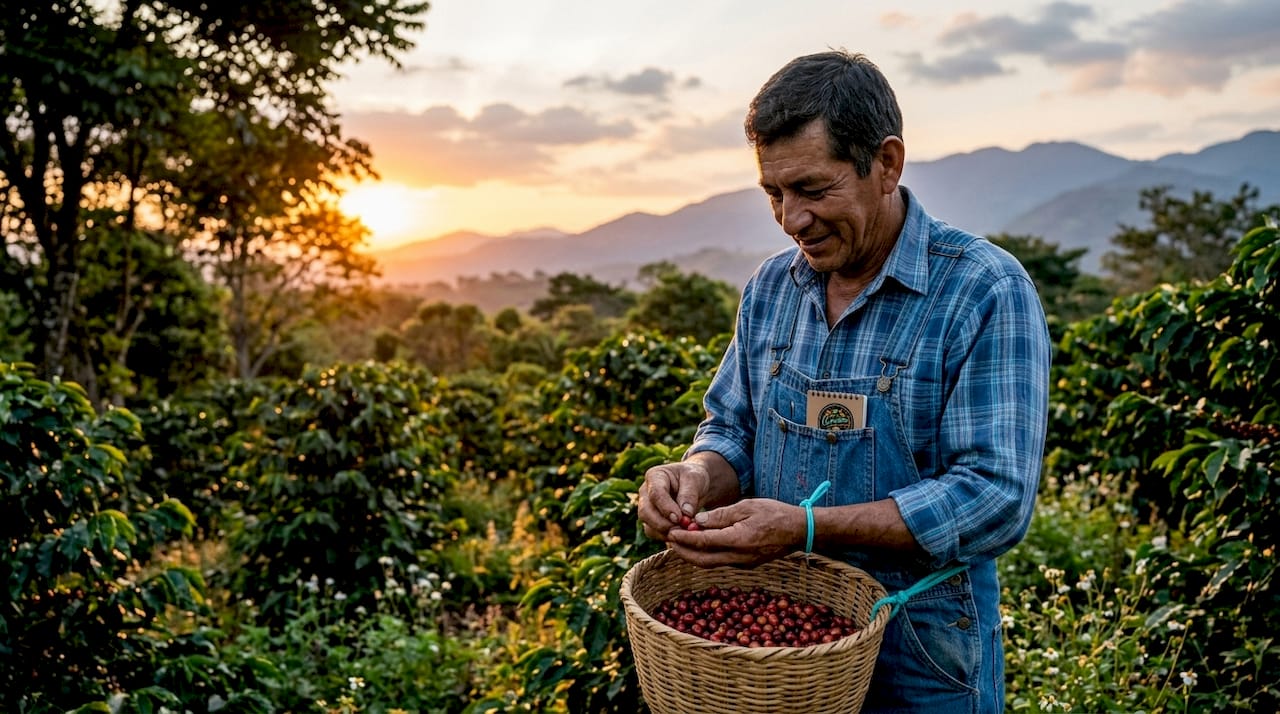
The social dimension is equally concrete. Sustainable coffee farming includes fair wages, safe working conditions, and community investment. In regions like Guatemala and Vietnam, generational renewal is a pressing issue. Young people are leaving farms because the economics do not work. When farmers earn prices above commodity market baselines and receive long-term purchasing commitments, they can invest in education, infrastructure, and better practices. Without that financial floor, no environmental standard survives contact with economic reality.
Key sustainable coffee practices include:
- Shade-grown cultivation to protect biodiversity and reduce chemical dependency
- Soil conservation techniques such as composting, cover crops, and contour planting
- Water management systems that minimize runoff and protect local watersheds
- Integrated pest management to reduce synthetic pesticide use
- Fair labor standards including living wages and safe working conditions
- Community development programs that invest in schools, healthcare, and infrastructure
Pro Tip: When evaluating a coffee brand’s sustainability claims, ask specifically whether the farms are shade-grown. This single practice correlates with better biodiversity outcomes, higher cup quality, and more resilient farming systems than almost any other variable.
How do certifications and regulations shape sustainable coffee?
Certifications are the most visible tool in sustainable coffee, but they are not the whole answer. Rainforest Alliance certification sets standards across soil health, pesticide use, worker rights, and climate action, integrating both environmental and social criteria into a single audit framework. Fairtrade focuses more explicitly on price floors and democratic cooperative structures. Both programs have genuine value, but neither was designed to satisfy the documentation demands of modern trade regulations.
The EU Deforestation Regulation (EUDR) changes the compliance picture significantly. EUDR requires geolocation data and risk assessment documentation for all coffee imports into the European Union, with large operators facing enforcement starting December 30, 2026. Missing geo-data can block market access entirely, regardless of what certifications a shipment carries. This is a structural shift. A Rainforest Alliance seal does not substitute for a verified GPS coordinate tied to a specific farm plot.
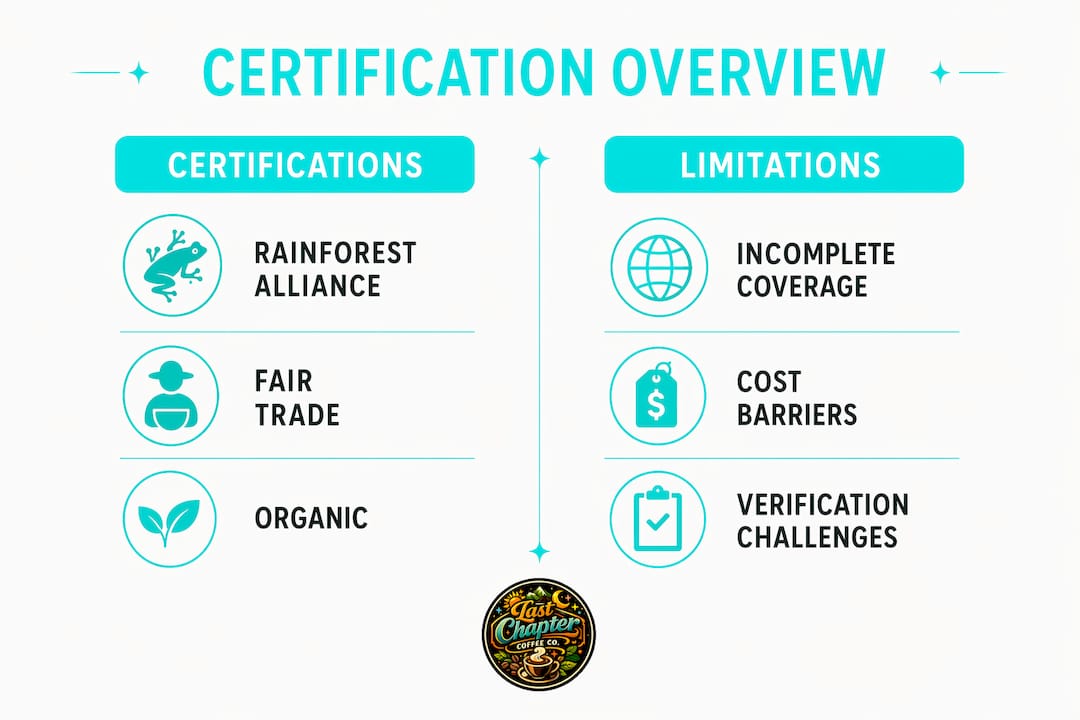
| Certification / Framework | Primary Focus | Limitation |
|---|---|---|
| Rainforest Alliance | Environmental and social standards | Does not provide geolocation data for EUDR |
| Fairtrade | Price floors and cooperative governance | Limited scope on environmental traceability |
| EUDR (2026) | Deforestation-free sourcing with verified data | Compliance burden falls heavily on smallholders |
| National programs (e.g., Costa Rica) | Coordinated traceability at scale | Requires government infrastructure and resources |
Costa Rica’s experience illustrates both the potential and the difficulty. The country’s EUDR compliance pilot georeferenced 40% of coffee farms and successfully shipped deforestation-free coffee to Europe. That result required coordinated national infrastructure, cooperative networks, and government support. Individual smallholders in less organized markets cannot replicate that outcome alone. Labels and certifications do not replace the due diligence statements and verifiable data that regulations now require.
Pro Tip: If you buy coffee sold into European markets, look for brands that publish due diligence documentation or supply chain maps. That level of transparency signals genuine compliance, not just certification badge collection.
What challenges and misconceptions exist around sustainable coffee?
The most persistent misconception about sustainable coffee is that it functions as a binary label. A coffee is not simply “sustainable” or “not sustainable.” Sustainability is a spectrum of practices, commitments, and outcomes that vary by farm, region, supply chain, and year. Treating it as a checkbox creates space for greenwashing and misleads consumers who want to make genuinely better choices.
Economic sustainability is the dimension most often ignored. Producer economic viability requires fair pricing, shared risk, and long-term purchasing commitments. Environmental practices cannot be maintained when farmers are losing money. A farm that adopts organic methods but sells at commodity prices below the cost of production is not sustainable, regardless of its certification status. The economics must work, or nothing else does.
Carbon accounting presents its own distortions. Many sustainability programs reward new tree planting because it is easy to measure and photograph. But protecting existing shade-grown agroforests delivers greater carbon and biodiversity value than planting new trees on degraded land. The incentive structure is misaligned, and that misalignment shapes where money flows and which farms get rewarded.
Smallholder compliance with certification and regulatory requirements is genuinely difficult. Most of the world’s coffee comes from farms smaller than five hectares. These farmers often lack the documentation systems, technical support, or financial resources to meet the data requirements of programs like EUDR. Scaling traceability works best through cooperatives and national programs, not individual farm-level compliance efforts.
Additional challenges worth understanding:
- Greenwashing risk: Vague terms like “eco-friendly” or “responsibly sourced” carry no verified standard behind them
- Market segmentation: Sustainability premiums often reach roasters and retailers but not the farmers who bear the cost of compliance
- Climate pressure: Changing rainfall patterns and rising temperatures are shrinking viable growing zones, making long-term farm investment harder to justify
- Consumer confusion: Multiple competing certification systems with different criteria make it hard to compare claims across brands
How can you choose coffee that is genuinely sustainable?
Choosing sustainable coffee well means looking past the label and asking harder questions about provenance, producer relationships, and purchasing commitments. True sustainability performance requires examining farming practices, community impact, and how a roaster or importer engages with growers over time. A brand that has worked with the same cooperative in Oaxaca for eight years is making a different kind of commitment than one that sources from the cheapest available lot with a certification sticker.
Here is a practical checklist for making better choices:
- Check for named origin. Bags that list a specific farm, cooperative, or region give you something to verify. Generic “Central American blend” tells you nothing about sourcing practices.
- Look for shade-grown or agroforestry claims. These practices correlate with better environmental outcomes and are harder to fake than broad sustainability language.
- Research the roaster’s sourcing model. Do they publish relationships with specific producers? Do they mention price transparency or direct trade commitments?
- Understand what certifications actually cover. Rainforest Alliance addresses environmental and social standards. Fairtrade focuses on price and cooperative structure. Neither alone guarantees full supply chain traceability.
- Favor brands that publish supply chain information. A sourcing map, producer profile, or due diligence statement signals accountability that a logo cannot.
Pro Tip: Single-origin coffees from cooperatives in countries with strong traceability infrastructure, like Ethiopia’s Yirgacheffe cooperatives or Colombia’s FNC-affiliated farms, give you a much cleaner line of sight to actual farming practices than blended commercial lots.
Key takeaways
Sustainable coffee requires environmental protection, social equity, and economic viability working together. Certifications signal intent but cannot replace verified data, transparent sourcing, and long-term producer commitments.
| Point | Details |
|---|---|
| Three-part definition | Sustainable coffee balances environment, social fairness, and economic viability. None of the three works without the other two. |
| Certifications have limits | Rainforest Alliance and Fairtrade set standards, but EUDR now requires verified geolocation data that labels alone cannot provide. |
| Economics must work | Farmers need prices above commodity baselines and long-term purchasing commitments to maintain sustainable practices. |
| Shade-grown systems matter | Protecting existing agroforests delivers more carbon and biodiversity value than new tree planting programs. |
| Consumer choices count | Buying from transparent roasters with named origins and documented producer relationships drives real accountability. |
Why I think we’ve been measuring sustainability wrong
The coffee industry has spent two decades building certification infrastructure, and that work has genuine value. But the dominant frameworks still reward what is easy to count: new trees planted, hectares certified, logos printed on bags. What they undercount is the harder, slower work of keeping existing biodiverse farms economically viable so that farmers do not convert them to more profitable monocultures.
I’ve watched this pattern play out repeatedly. A farm in Honduras earns a certification, receives a modest premium, and still cannot cover the cost of compliance the following year. The certification lapses. The shade trees come down. The biodiversity value that took decades to build disappears in a season. No carbon credit was ever issued for what was lost.
The EUDR is the first regulatory framework that forces the industry to operationalize sustainability through data rather than declarations. That is uncomfortable for a lot of actors in the supply chain, and the compliance burden on smallholders is real and serious. But the direction is right. Verified geolocation, risk assessment, and due diligence documentation create accountability that a logo never could.
As a consumer, your role is not to achieve perfect knowledge of every farm in your supply chain. It is to favor brands that are trying to build that knowledge and share it with you. Ask questions. Read sourcing pages. Support roasters who name their producers. The collective weight of informed purchasing is the most direct signal the market receives.
— Rogee
Explore sustainable coffee at Last Chapter Coffee
Last Chapter Coffee sources artisan blends with a focus on quality and producer relationships that go beyond surface-level certification. The African Kahawa Blend draws from biodiverse growing regions where shade-grown farming practices are part of the local tradition, not a marketing add-on. For espresso drinkers, the African Espresso delivers the same commitment to traceable, quality-forward sourcing in a format built for intensity. Every order ships free within the US, and the full coffee collection gives you a direct way to put your purchasing power behind the practices this article describes.
FAQ
What is sustainable coffee in simple terms?
Sustainable coffee is coffee produced through farming and supply chain practices that protect the environment, support farmer livelihoods, and maintain economic viability. It addresses issues from deforestation to fair labor across the full supply chain from seed to cup.
What makes a coffee certification like Rainforest Alliance reliable?
Rainforest Alliance certification sets verified standards on soil health, pesticide use, worker rights, and climate action, making it a credible signal of environmental and social commitment. It does not, however, provide the geolocation data now required by the EU Deforestation Regulation for market access.
Why does shade-grown coffee matter for sustainability?
Shade-grown coffee agroforests deliver higher carbon sequestration and biodiversity value than sun-grown alternatives or new tree planting programs. Protecting these existing systems is one of the highest-impact actions in sustainable coffee farming.
How does the EUDR affect sustainable coffee in 2026?
The EU Deforestation Regulation requires verified geolocation and risk assessment documentation for all coffee imports into the EU, with large operator enforcement beginning December 30, 2026. Certifications alone do not satisfy these requirements. Brands must provide traceable, evidence-based sourcing data.
How do I choose sustainable coffee as a consumer?
Look for named origins, shade-grown claims, and roasters who publish producer relationships and sourcing documentation. Single-origin coffees from cooperative-based regions offer more supply chain visibility than generic blended lots with broad sustainability language.


